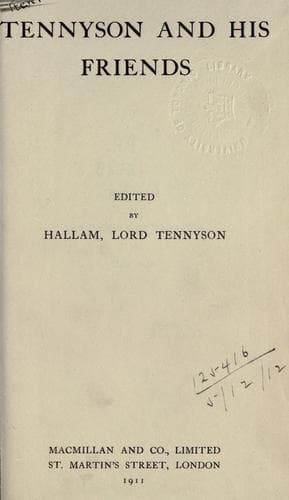
Tennyson, Alfred Tennyson, Baron, 1809-1892 -- Friends and associates
This sweet, even life knew little variety. The days of quiet service
filled the year, and were succeeded by evenings no less quiet in the
book-lined study, or, if the season were warm, in the hayfield near the
house, where husband and wife would sit reading and talking to each other
till the evening glow died away and left the haycocks and the steep side
of the wold, which backed the red-brick Vicarage, gray and cold and
silent.
Troubles they had beyond the recurrent anxiety for Charles's health. A
rascally agent, a man of great plausibility and charm of manner, pillaged
them for some years, and they were only able to recover a portion of his
plunderings (most of which Charles subsequently devoted to the repair of
the church) after a great deal of trouble. It is characteristic that in
after years they always spoke of this gentleman as though _he_ had been
the person who had suffered most in the transaction and deserved most
pity. Charles was indeed possessed of an almost saintly patience, and no
crisis could ever wring from him any ejaculation more forcible than a
half-humorous "I wish we were all in heaven." His wife's letters
occasionally give us glimpses of days when the wish must often have been
upon his lips, as when he was reluctantly compelled to join in a
Harvest-Festival gathering in another parish. First of all we read how
"poor Cubbie" (his wife's pet name for him) "was caught and dressed in a
surplice which hung about him like a clothes bag." "Then he must join in a
procession, with much singing and chanting, and then read the lessons in
spite of a bad cold and hoarseness, and finally at the end of the day, in
the full hubbub of a garden party, at which all the neighbourhood were
present in their finery (poor Cubbie!), a cannon, which had been charged
with blank cartridge for the occasion, went off unexpectedly and knocked
down three boys who were standing in front of it. The boys, whose clothes
were torn to rags and their faces burnt black, shrieked as though in the
death agony, women fainted and men stampeded--and Cubbie 'wished we were
all in heaven.'"
But Charles Turner's poems are, after all, the best mirror of his life.
With Frederick it is otherwise. In spite of his great lyric gift,
Frederick lacked the persistence and enthusiasm necessary for full
self-expression. The want of proportion, which gave his ardent, erratic
personality so much charm, prevented his longer poems being really
successful. In spite of much beauty of phrase and richness of feeling,
they lack architecture and have not sufficient unity to make them vital.
Had he continued to work at lyrical writing after his first volume, he
might have avoided falling into the desultory method, which marred his
later work, and left a really large body of first-class poetry.
Public-domain text, read in full here on John Shaqi.
Reviews
Reviews
No reviews yet
Be the first to share your thoughts on this work.
Join the Discussion
Join the discussion
Sign in to leave a comment or review.
Sign InorCreate an account