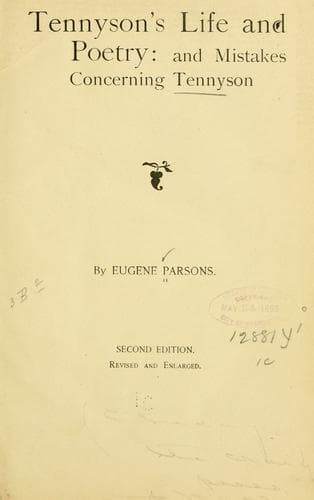
Tennyson's Life and Poetry: And Mistakes Concerning TennysonParsons, Eugene
General
Tennyson's Life and Poetry: And Mistakes Concerning Tennyson
Parsons, Eugene
Tennyson, Alfred Tennyson, Baron, 1809-1892
It may not be widely known that Baron Tennyson has a splendid lineage, of
which he has modestly kept silent, unlike Byron. According to a writer in
the _St. James' Gazette_, who traced his ancestry back to Norman times,
Tennyson is descended from an illustrious house of "princes, soldiers, and
statesmen, famous in British or European history." Some of his remote
relatives were crowned heads--one being the celebrated Malcolm III. of
Scotland. In Tennyson's descent "two lines are blended," says Church, "the
middle class line of the Tennysons, and the noble and even royal line of
the D'Eyncourts."[9]
Alfred's uncle, the Right Hon. Charles Tennyson-D'Eyncourt of Bayons Manor
in Lincolnshire, was a man of marked ability and culture, who held
various public offices, and represented several boroughs in parliament
from 1818 to 1852. Since his death, in 1861, the family estate has
successively passed to his three sons--George Hildyard, Admiral Edwin
Clayton, C. B. (1871), and Louis Charles (1890), the present inheritor of
the D'Eyncourt seat and dignity.
The poet's last years have been clouded by the bereavement of many old
friends and relatives. Septimus, Charles,[10] Mary,[11] Emily,[12] and
Edward are dead. He suffered a severe blow in the death of his second son
Lionel, while on the homeward voyage from India.[13] He mourns his loss in
the touching stanzas--"To the Marquis of Dufferin and Ava."
Lord Tennyson was the recipient of many congratulations on the occasion of
his eightieth birthday, August 6, 1889. The same year was marked by the
publication of a new volume of poems, which attest that his intellectual
vigor is unimpaired by age or bodily weakness. A dainty little poem of
his--"To Sleep"--was published in the _New Review_ for March, 1891, and it
is not improbable that others will see the light in the near future.
Tennyson's health, though quite robust for an octogenarian, has been
broken of late. In the spring of 1890, he was troubled with a grievous
illness, the result of exposure to cold--he having persisted in taking his
"daily two hours' walk along the cliff" in all kinds of weather. It was
expected that the poet would spend the following winter in the South to
avoid the rigorous climate of the Isle of Wight, but he recovered
sufficient strength to remain at Farringford House amid the scenes he
loves so well.
Public-domain text, read in full here on John Shaqi.
Reviews
Reviews
No reviews yet
Be the first to share your thoughts on this work.
Join the Discussion
Join the discussion
Sign in to leave a comment or review.
Sign InorCreate an account