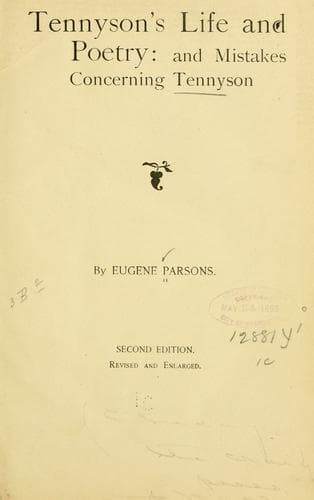
Tennyson's Life and Poetry: And Mistakes Concerning Tennyson — John Shaqi
Tennyson's Life and Poetry: And Mistakes Concerning TennysonParsons, Eugene
General
Tennyson's Life and Poetry: And Mistakes Concerning Tennyson
Parsons, Eugene
Tennyson, Alfred Tennyson, Baron, 1809-1892
Tennyson has always shunned publicity, living in a world apart--removed
from the gaze of the profane crowd. He rarely goes into society,
preferring rural retirement to social converse. As poet and man, he has
gained by this voluntary seclusion. His delight is to mingle with the
world of nature. The woods and skies, the streams and billows have been
his comrades. How much they have contributed to his poetic greatness
cannot be estimated. He is, however, a recluse with his eyes open. He has
watched the progress of mankind and observed the trend of the times.
Realizing the needs of the age, he grandly rose to the occasion--either to
lift up his voice in protest against its faults, or to sing its
achievements.
For many years no strangers have been admitted to Farringford Park.
Visitors, while welcome at Aldworth in the afternoon, have not been
allowed to interrupt the accustomed occupations of the master of the
house, who is very methodical in his habits. It has long been his custom
to rise early and spend the morning hours in his study--writing and
dreaming in an atmosphere laden with smoke and the odor of tobacco. He now
uses the pen but little, owing to failing eyesight. The Honorable Hallam
Tennyson is his secretary and constant companion.
Personally, his lordship is a man who would attract attention anywhere,
with his stalwart form slightly stooping, his noble face, his long flowing
hair and bushy beard. He dresses carelessly, and when out of doors wears a
shocking bad hat; with his cloak and walking-stick, he makes a picturesque
figure. He is a confirmed pedestrian. "Every morning," says a newspaper
correspondent, "in hail, rain or snow, the poet dons his frouzy cap and
his frouzier slouch hat, and promenades for an hour or so, none daring to
disturb him."
Tennyson is taciturn and brusque before strangers, whose presence annoys
him, but he is delightfully easy and spontaneous with friends. Edward
Fitzgerald, in his letters to Frederick Tennyson and others, alludes again
and again, in terms of enthusiastic appreciation, to Alfred's wise and
pointed conversation. One of his original "sayings, which strike the nail
on the head," was about Dante. It is well worth quoting in Fitzgerald's
concise language, taken from a letter written in 1876:
"What Mr. Lowell says of him recalled to me what Tennyson said to me some
thirty-five or forty years ago. We were stopping before a shop in Regent
street where were two figures of Dante and Goethe. I (I suppose) said,
'What is there in old Dante's face that is missing in Goethe's?' And
Tennyson (whose profile then had certainly a remarkable likeness to
Dante's) said: 'The divine.'"
Public-domain text, read in full here on John Shaqi.
Reviews
Reviews
No reviews yet
Be the first to share your thoughts on this work.
Join the Discussion
Join the discussion
Sign in to leave a comment or review.
Sign InorCreate an account