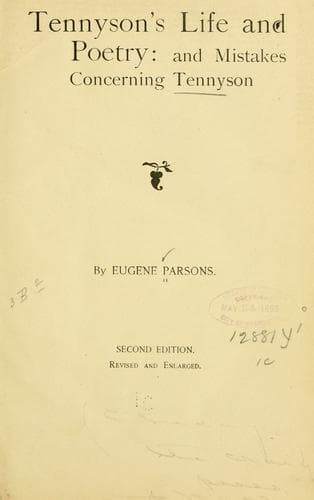
Tennyson's Life and Poetry: And Mistakes Concerning TennysonParsons, Eugene
General
Tennyson's Life and Poetry: And Mistakes Concerning Tennyson
Parsons, Eugene
Tennyson, Alfred Tennyson, Baron, 1809-1892
In 1833, the sudden death of Hallam, then Emily's betrothed, produced on
Alfred's mind a deep and ineffaceable impression. While brooding over his
sorrow, the idea came to him of expressing his emotions in verse which
might be a fitting tribute to the dead. At different times and amid widely
varying circumstances, were composed the elegiac strains and poetic
musings that make up "In Memoriam," a poem representing many moods and
experiences. It is a work occupying a place apart in literature. Its
merits and defects are peculiar. There is no other elegy like it, and it
may be doubted whether a second In Memoriam will ever be written. Tennyson
erected an appropriate and imperishable monument to the memory of his lost
friend. In conferring immortality upon his beloved Arthur, he gained it
for himself. His best claim on the future is to be known and remembered as
the author of "In Memoriam," his masterpiece.
Equally enduring is the melodious wail--"Break, break, break," one of the
sweetest dirges in all literature. Hallam was buried (Jan. 3, 1834) at
Clevedon by the Severn, near its entrance to the Bristol Channel, within
sound of the melancholy waves. Singularly this exquisite song, which
breathes of the sea, was not composed here, but "in a Lincolnshire lane at
five o'clock in the morning," as the Laureate himself has declared. It was
written within a year after Hallam's death, Sept. 15, 1833.
Not much has been learned of Tennyson's early manhood. No very definite
picture can be formed of his life after he left college. He seldom wrote
letters. Even his most intimate friends could not succeed in carrying on a
correspondence with him. What happened to him is not, however, all a
blank. A few scraps relating to his history are found in the letters of
Carlyle, Fitzgerald, Milnes and others. A number of autobiographical
fragments are sprinkled through the poems which he wrote between 1830 and
1850, but they refer more to his spiritual development than to the outward
events which constitute memoirs.
Mrs. Tennyson and her family continued to live at the Rectory after her
husband died, March 16, 1831. In the autumn of 1835, she removed to High
Beach, Epping Forest, ("In Memoriam," CII., CIV., CV.), and about 1840 to
Well Walk, Hampstead. Here she made her home the rest of her life with her
sister, Mary Ann Fytche--nearly all of her sons and daughters having
married and scattered. She died February 21, 1865, at the age of
eighty-four.
Alfred's university career was cut short by his father's death. For some
years he remained at home--a diligent student of books and a close
observer of nature. He roamed back and forth between Somersby and London,
alternately in solitude and with his friends.[4] Fitzgerald tells of his
visiting with Tennyson at the Cumberland home of James Spedding in 1835.
Public-domain text, read in full here on John Shaqi.
Reviews
Reviews
No reviews yet
Be the first to share your thoughts on this work.
Join the Discussion
Join the discussion
Sign in to leave a comment or review.
Sign InorCreate an account