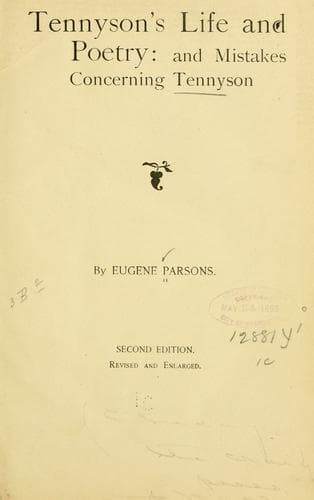
Tennyson's Life and Poetry: And Mistakes Concerning TennysonParsons, Eugene
General
Tennyson's Life and Poetry: And Mistakes Concerning Tennyson
Parsons, Eugene
Tennyson, Alfred Tennyson, Baron, 1809-1892
Here Alfred would spend hour after hour reading aloud "Morte d'Arthur" and
other unpublished poems, which his scholarly friend criticized. In 1838,
he was a welcome member of the Anonymous Club in London, and for several
years he had rooms in this city at various intervals.[5] It was his custom
to make long incursions through the country on foot, studying the
landscapes of England and Wales and pondering many a lay unsung. Thus he
became familiar with the natural features of the places illustrated in his
poems with such pictorial fidelity and vividness, though not with
photographic accuracy.
Through this long period he was unknown to the great world. He lived
modestly, though not in actual want. His books brought him no substantial
returns till long after 1842. There was but little left of his patrimony,
if any, when he was granted a pension of £200 in 1845. This timely aid was
obtained for him by Sir Robert Peel, chiefly through the influence of
Carlyle and Milnes.
Henceforth fortune graciously smiled upon him and made amends for past
neglect. His reputation was becoming well established, and new editions of
his poems were being called for. The Queen chanced to pick up one of his
earlier volumes, and was charmed with the simple story of "The Miller's
Daughter." She procured a copy of the book for the Princess Alice; this
incident, it is related, brought him into favor with the aristocracy and
gave a tremendous impetus to his popularity. After the death of Wordsworth
in 1850, Tennyson was appointed Poet Laureate. Since then he has been
highly esteemed by the royal family, and has produced in their honor some
spirited odes and stately dedications.
The poet married (June 13, 1850) Miss Emily Sellwood, of Horncastle, whom
he had known from childhood. Her mother was a sister of Sir John Franklin,
and her youngest sister was the wife of Charles Tennyson Turner. Two or
three years they lived at Twickenham, where Hallam Tennyson was born in
1852. Together they visited Italy in 1851, and vivid memories of their
travels are recalled in "The Daisy," addressed to his wife. This
interesting poem, written at Edinburgh, was suggested by the finding of a
daisy in a book--the flower having been plucked on the Splugen and placed
by Mrs. Tennyson between the leaves of a little volume as a memento of
their Italian journey. The poet's fancy was stirred and revived the
delicious hours--
In lands of palm and southern pine;
In lands of palm, of orange blossom,
Of olive, aloe, and maize and vine.
Public-domain text, read in full here on John Shaqi.
Reviews
Reviews
No reviews yet
Be the first to share your thoughts on this work.
Join the Discussion
Join the discussion
Sign in to leave a comment or review.
Sign InorCreate an account