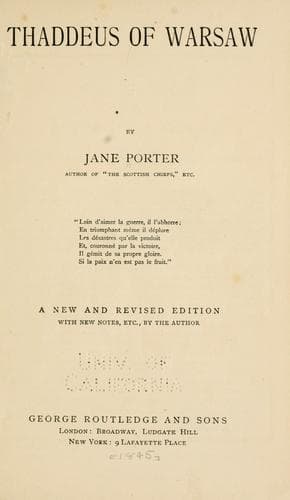
Poland -- History -- Stanislaus II Augustus, 1764-1795 -- Fiction
Everything that presented itself to Mr. Somerset was new and
fascinating. He saw in the domestic felicity of his friend scenes
which reminded him of the social harmony of his own home. He beheld
in the palace and retinue of Sobieski all the magnificence which
bespoke the descendant of a great king, and a power which wanted
nothing of royal grandeur but the crown, which he had the magnanimity
to think and to declare was then placed upon a more worthy brow.
Whilst Somerset venerated this true patriot, the high tone his mind
acquired was not lowered by associating with characters nearer the
common standard. The friends of Sobieski were men of tried probity--
men who at all times preferred their country's welfare before their
own peculiar interest. Mr. Somerset day after day listened with deep
attention to these virtuous and energetic noblemen. He saw them full
of fire and personal courage when the affairs of Poland were
discussed; and he beheld with admiration their perfect forgetfulness
of themselves in their passion for the general good. In these moments
his heart bowed down before them, and all the pride of a Briton
distended his breast when he thought that such men as these his
ancestors were. He remembered how often their chivalric virtues used
to occupy his reflections in the picture-gallery at Somerset Castle,
and his doubts, when he compared what is with what was, that history
had glossed over the actions of past centuries, or that a different
order of men lived then from those which now inhabit the world. Thus,
studying the sublime characters of Sobieski and his friends, and
enjoying the endearing kindness of Thaddeus and his mother, did a
fortnight pass away without his even recollecting the promise of
writing to his governor. At the end of that period, he stole an hour
from the countess's society, and enclosed in a short letter to Mr.
Loftus the following epistle to his mother:--
To LADY SOMERSET, SOMERSET CASTLE, LEICESTERSHIRE.
"Many weeks ago, my dearest mother, I wrote a letter of seven sheets
from the banks of the Neva, which, long ere this time, you and my
dear father must have received. I attempted to give you some idea of
the manners of Russia, and my vanity whispers that I succeeded
tolerably well. The court of the famous Catharine and the attentions
of the hospitable Count Brinicki were then the subjects of my pen.
Public-domain text, read in full here on John Shaqi.
Reviews
Reviews
No reviews yet
Be the first to share your thoughts on this work.
Join the Discussion
Join the discussion
Sign in to leave a comment or review.
Sign InorCreate an account