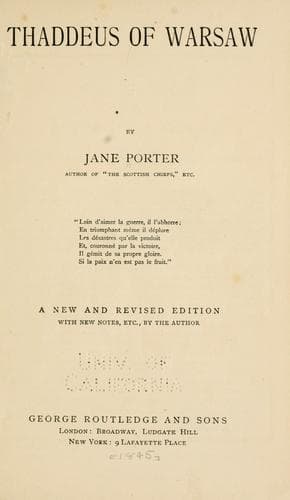
Poland -- History -- Stanislaus II Augustus, 1764-1795 -- Fiction
"But how shall I account for my being here? How shall I allay your
surprise and displeasure on seeing that this letter is dated from
Warsaw? I know that I have acted against the wish of my father in
visiting one of the countries he proscribes. I know that I have
disobeyed your commands in ever having at any period of my life taken
up arms without an indispensable necessity; and I have nothing to
allege in my defence. I fell in the way of temptation, and I yielded
to it. I really cannot enumerate all the things which induced me to
volunteer with my Russian friends; suffice it to say that I did so,
and that we were defeated by the Poles at Zielime; and as Heaven has
rather rewarded your prayers than punished my imprudence, I trust you
will do the same, and pardon an indiscretion I vow never to repeat.
"Notwithstanding all this, I must have lost my life through my folly,
had I not been preserved, even in the moment when death was pending
over me, by a young officer with whose family I now am. The very
sound of their title will create your respect; for we of the
patrician order have a strange tenacity in our belief that virtue is
hereditary, and in this instance our creed is duly honored. Their
patronymic is Sobieski; the family which bears it is the only
remaining posterity of the great monarch of that name; and the count,
who is at its head, is Palatine of Masovia, which, next to the
throne, is the first dignity in the state. He is one of the warmest
champions of his country's rights; and though born to command, has so
far transgressed the golden adage of despots, 'Ignorance and
subjection,' that throughout his territories every man is taught to
worship his God with his heart as well as with his knees. The
understandings of his peasants are opened to all useful knowledge. He
does not put books of science and speculation into their hands, to
consume their time in vain pursuits: he gives them the Bible, and
implements of industry, to afford them the means of knowing and of
practising their duty. All Masovia around his palace blooms like a
garden. The cheerful faces of the farmers, and the blessings which I
hear them implore on the family when I am walking in the field with
the young count (for in this country the sons bear the same title
with their fathers [Footnote: _Prince_, (ancient _Kniaz_) and
_Boyard_, (which is equivalent in rank to our old English Baron,)
are titles used by Russians and Polanders, both nations being descended
from the Sclavonians, and their languages derived from the same roots.
_Prince_ indicates the highest rank of a subject; _Boyard_
simply that of _Nobleman_. But both personages must be understood
to be of hereditary power to raise forces on their estates for the service
of the sovereign, to lead them in battle, and to maintain all their
expenses. The title of _Count_ has been adopted within a century or
two by both nations, and occasionally appended to the ancient heroic
designation of _Boyard_.
Public-domain text, read in full here on John Shaqi.
Reviews
Reviews
No reviews yet
Be the first to share your thoughts on this work.
Join the Discussion
Join the discussion
Sign in to leave a comment or review.
Sign InorCreate an account