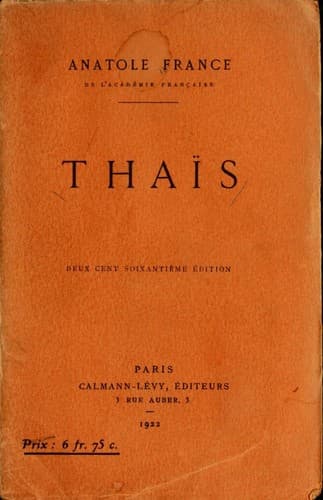
Christian women saints -- Fiction; Christianity, Conversion to -- Fiction; Courtesans -- Fiction; Egypt -- Fiction; Hermits -- Fiction
“It is the same to me whether I speak or remain silent. I will give my
reasons without asking yours in return, for I have no interest in you
at all. I care neither for your happiness nor your misfortune, and it
matters not to me whether you think one way or another. Why should I
love you, or hate you? Aversion and sympathy are equally unworthy of the
wise man. But since you question me, know then that I am named Timocles,
and that I was born at Cos, of parents made rich by commerce. My father
was a shipowner. In intelligence he much resembled Alexander, who is
surnamed the Great. But he was not so gross. In short, he was a man of
no great parts. I had two brothers, who, like him, were shipowners. As
for me, I followed wisdom. My eldest brother was compelled by my father
to marry a Carian woman, named Timaessa, who displeased him so greatly
that he could not live with her without falling into a deep melancholy.
However, Timaessa inspired our younger brother with a criminal passion,
and this passion soon turned to a furious madness. The Carian woman
hated them both equally; but she loved a flute-player, and received him
at night in her chamber. One morning he left there the wreath which he
usually wore at feasts. My two brothers, having found this wreath, swore
to kill the flute-player, and the next day they caused him to perish
under the lash, in spite of his tears and prayers. My sister-in-law
felt such grief that she lost her reason, and these three poor wretches
became beasts rather than human beings, and wandered insane along the
shores of Cos, howling like wolves and foaming at the mouth, and hooted
at by the children, who threw shells and stones at them. They died, and
my father buried them with his own hands. A little later his stomach
refused all nourishment, and he died of hunger, though he was rich
enough to have bought all the meats and fruits in the markets of Asia.
He was deeply grieved at having to leave me his fortune. I used it in
travels. I visited Italy, Greece, and Africa without meeting a single
person who was either wise or happy. I studied philosophy at Athens and
Alexandria, and was deafened by noisy arguments. At last I wandered as
far as India, and I saw on the banks of the Ganges a naked man, who had
sat there motionless with his legs crossed for more than thirty years.
Climbing plants twined round his dried up body, and the birds built
their nests in his hair. Yet he lived. At the sight of him I called to
mind Timaessa, the flute-player, my two brothers, and my father, and
I realised that this Indian was a wise man. ‘Men,’ I said to myself,
‘suffer because they are deprived of that which they believe to be good;
or because, possessing it they fear to lose it; or because they endure
that which they believe to be an evil. Put an end to all beliefs of this
kind, and the evils would disappear.’ That is why I resolved henceforth
to deem nothing an advantage, to tear myself entirely from the good
Public-domain text, read in full here on John Shaqi.
Reviews
Reviews
No reviews yet
Be the first to share your thoughts on this work.
Join the Discussion
Join the discussion
Sign in to leave a comment or review.
Sign InorCreate an account