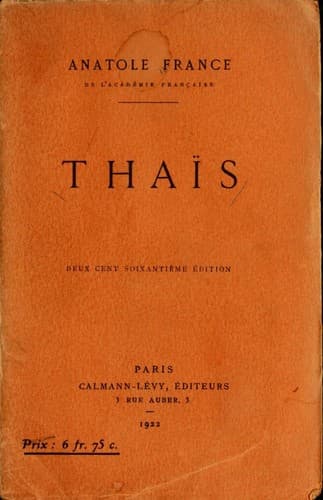
Christian women saints -- Fiction; Christianity, Conversion to -- Fiction; Courtesans -- Fiction; Egypt -- Fiction; Hermits -- Fiction
The initiation lasted a whole year, till the time when the Christians
joyfully celebrate the festival of Easter. One night in the holy week,
Thais, who was already asleep on her mat, felt herself lifted by the
slave, whose eyes gleamed with a strange light. He was clad, not as
usual in a pair of torn drawers, but in a long white cloak, beneath
which he pressed the child, whispering to her--
“Come, my soul! Come, light of my eyes! Come, little sweetheart! Come
and be clad in the baptismal robes!”
He carried the child pressed to his breast. Frightened and yet curious,
Thais, her head out of the cloak, threw her arms round her friend’s
neck, and he ran with her through the darkness. They went down narrow,
black alleys; they passed through the Jews’ quarter; they skirted a
cemetery, where the osprey uttered its dismal cry; they traversed an
open space, passing under crosses on which hung the bodies of victims,
and on the arms of the crosses the ravens clacked their beaks. Thais
hid her head in the slave’s breast. She did not dare to peep out all
the rest of the way. Soon it seemed to her that she was going down under
ground. When she reopened her eyes she found herself in a narrow cave,
lighted by resin torches, on the walls of which were painted standing
figures, which seemed to move and live in the flickering glare of the
torches. They were men clad in long tunics and carrying branches of
palm, and around them were lambs, doves, and tendrils of vine.
Amongst these figures, Thais recognised Jesus of Nazareth, by the
anemones flowering at his feet. In the centre of the cave, near a
large stone font filled with water, stood an old man clad in a scarlet
dalmatic embroidered with gold, and on his head a low mitre. His thin
face ended in a long beard. He looked gentle and humble, in spite of
his rich costume. This was Bishop Vivantius, an exiled dignitary of the
Church of Cyrene, who now gained his livelihood by weaving common stuffs
of goats’ hair. Two poor children stood by his side. Close by, an old
negress unfolded a little white robe. Ahmes set the child down on the
ground, and kneeling before the Bishop, said--
“Father, this is the little soul, the child of my soul. I have brought
her that you may, according to your promise, and if it please your
holiness, bestow on her the baptism of life.”
At these words the Bishop opened his arms, and showed his mutilated
hands. His nails had been torn out because he had maintained the faith
in the days of persecution. Thais was frightened, and threw herself into
the arms of Ahmes. But the kind words of the priest reassured her.
“Fear nothing, dearly beloved little one. Thou hast here a spiritual
father, Ahmes, who is called Theodore amongst the faithful, and a kind
mother in grace, who has prepared for thee, with her own hands, a white
robe.”
And turning towards the negress--
“She is called Nitida,” he added, “and is a slave in this world, but in
heaven she will be a spouse of Jesus.”
Public-domain text, read in full here on John Shaqi.
Reviews
Reviews
No reviews yet
Be the first to share your thoughts on this work.
Join the Discussion
Join the discussion
Sign in to leave a comment or review.
Sign InorCreate an account