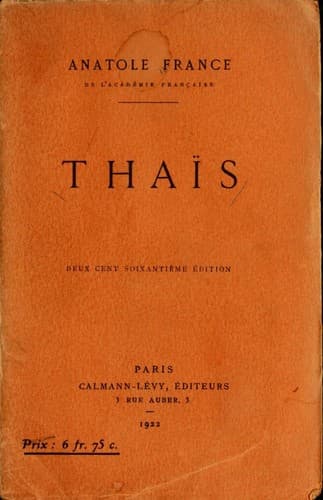
Christian women saints -- Fiction; Christianity, Conversion to -- Fiction; Courtesans -- Fiction; Egypt -- Fiction; Hermits -- Fiction
“Did you say, Drosea, that the gods loved you?” asked Nicias, smiling.
“Then they must share the same infirmities as men. Love presupposes
unhappiness on the part of whoever suffers from it, and is a proof of
weakness. The affection they feel for Drosea is a great proof of the
imperfection of the gods.”
At these words Drosea flew into a great rage.
“Nicias, your remarks are foolish and not to the point. But that is your
character--you never understand what is said, and reply in words devoid
of sense.”
Nicias smiled again.
“Talk away, talk away, Drosea. Whatever you say, we are glad every time
you open your mouth. Your teeth are so pretty!”
At that moment, a grave-looking old man, negligently dressed, walking
slowly, with his head high, entered the room, and gazed at the guests
quietly. Cotta made a sign to him to take a place by his side, on the
same couch.
“Eucrites,” he said, “you are welcome. Have you composed a new treatise
on philosophy this month? That would make, if I calculate correctly, the
ninety-second that has proceeded from the Nile reed you direct with an
Attic hand.”
Eucrites replied, stroking his silver beard--
“The nightingale was created to sing, and I was created to praise the
immortal gods.”
DORION. Let us respectfully salute, in Eucrites, the last of the stoics.
Grave and white, he stands in the midst of us like the image of an
ancestor. He is solitary amidst a crowd of men, and the words he utters
are not heard.
EUCRITES. You deceive yourself, Dorion. The philosophy of virtue is not
dead. I have numerous disciples in Alexandria, Rome, and Constantinople.
Many of the slaves, and some of the nephews of Caesar, now know how to
govern themselves, to live independently, and being unconcerned with all
affairs, they enjoy boundless happiness. Many of them have revived, in
their own person, Epictetus and Marcus Aurelius. But if it were true
that virtue were for ever extinguished upon the earth, in what way
would the loss of it affect my happiness, since it did not depend on
me whether it existed or perished? Only fools, Dorion, place their
happiness out of their own power. I desire nothing that the gods do not
wish, and I desire all that they do wish. By that means I render myself
like unto them, and share their infallible content. If virtue perishes,
I consent that it should perish, and that consent fills me with joy, as
the supreme effort of my reason or my courage. In all things my wisdom
will copy the divine wisdom, and the copy will be more valuable than the
model; it will have cost greater care and more work.
NICIAS. I understand. You put yourself on the same level as divine
providence. But if virtue consists only in effort, Eucrites, and in that
intense application by which the disciples of Zeno pretend to render
themselves equal to the gods, the frog, which swelled itself out to try
and become as big as the ox, accomplished a masterpiece of stoicism.
Public-domain text, read in full here on John Shaqi.
Reviews
Reviews
No reviews yet
Be the first to share your thoughts on this work.
Join the Discussion
Join the discussion
Sign in to leave a comment or review.
Sign InorCreate an account