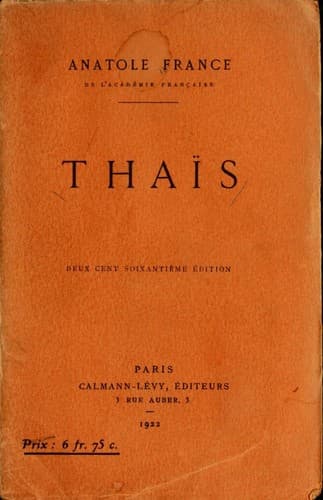
Christian women saints -- Fiction; Christianity, Conversion to -- Fiction; Courtesans -- Fiction; Egypt -- Fiction; Hermits -- Fiction
EUCRITES. You jest, Nicias, and, as usual, you excel in ridicule. But
if the ox of which you speak is really a god, like Apis, or like that
subterranean ox whose high priest I see here, and if the frog, being
wisely inspired, succeed in equalling it, would it not be, in fact,
more virtuous than the ox, and could you refrain from admiring such a
courageous little animal!
Four servants placed on the table a wild pig, still covered with its
bristles. Little pigs, made of pastry, surrounded the animal, as though
they would suckle, to show that it was a sow.
Zenothemis, turning towards the monk, said--
“Friends, a guest has come hither to join us. The illustrious
Paphnutius, who leads such an extraordinary life of solitude, is our
unexpected guest.”
COTTA. You may even add, Zenothemis, that the place of honour is due to
him, because he came without being invited.
ZENOTHEMIS. Therefore, we ought, my dear Lucius, to make him the more
welcome, and strive to do that which would be most agreeable to him. Now
it is certain that such a man cares less for the perfumes of meat than
for the perfumes of fine thoughts. We shall, doubtless, please him by
discussing the doctrine he professes, which is that of Jesus crucified.
For my own part, I shall the more willingly discuss this doctrine,
because it keenly interests me, on account of the number and the
diversity of the allegories it contains. If one may guess at the
spirit by the letter, it is filled with truths, and I consider that
the Christian books abound in divine revelations. But I should not,
Paphnutius, grant equal merit to the Jewish books. They were inspired
not, as it was said, by the Spirit of God, but by an evil genius. Iaveh,
who dictated them, was one of those spirits who people the lower air,
and cause the greater part of the evils, from which we suffer; but he
surpassed all the others in ignorance and ferocity. On the contrary, the
serpent with golden wings, which twined its azure coils round the tree
of knowledge, was made up of light and love. A combat between these
two powers--the one of light and the other of darkness--was, therefore,
inevitable. It occurred soon after the creation of the world. God had
hardly begun to rest after His labors; Adam and Eve, the first man and
the first woman, lived happy and naked in the Garden of Eden, when Iaveh
conceived--to their misfortune--the design of governing them and all
the generations which Eve already bore in her splendid loins. As he
possessed neither the compass nor the lyre, and was equally ignorant of
the science which commands and the art which persuades, he frightened
these two poor children by hideous apparitions, capricious threats,
and thunder-bolts. Adam and Eve, feeling his shadow upon them, pressed
closer to one another, and their love waxed stronger in fear. The
serpent took pity on them, and determined to instruct them, in order
that, possessing knowledge, they might no longer be misled by lies. Such
Public-domain text, read in full here on John Shaqi.
Reviews
Reviews
No reviews yet
Be the first to share your thoughts on this work.
Join the Discussion
Join the discussion
Sign in to leave a comment or review.
Sign InorCreate an account