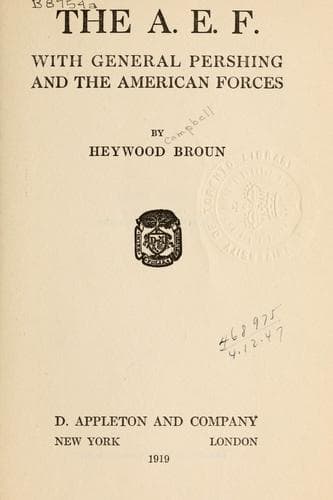
The A. E. F.: With General Pershing and the American ForcesBroun, Heywood
History
The A. E. F.: With General Pershing and the American Forces
Broun, Heywood
United States. Army. American Expeditionary Forces; World War, 1914-1918 -- Personal narratives
The increase in artillery activity had hardly begun on the day we paid
our visit. No German shells fell near us as we crossed the meadow, but
when we reached a battalion headquarters the major in charge pointed
with pride to a German shell which had landed on top of his kitchen that
morning. The rain had played him a good service, for the shell simply
buried itself, fragments and all. He did not seem properly appreciative
of the weather. "All Gaul," he said, "is divided into three parts and
two of them are water."
Still, we found ourselves drier in the trenches than out of them. They
were floored with boards and well lined. As trenches go they were good,
but, of course, that isn't saying a great deal. We were the first
newspapermen to enter the American trenches and so we wanted to see the
first line, although it was growing dark. We wound around and around
for many yards and it was hard walking for some of us, as the French had
built these trenches for short men. It was necessary to walk with a
crouch like an Indian on the movie warpath. This was according to
instructions, but we may have been unduly cautious, for not a hostile
shot was fired while we were in the first line. It was barely possible
to see the German trenches through the mist and still more difficult to
realize that there was a menace in the untidy welts of mud which lay at
the other side of the meadow. But the point from which we looked across
to the German line was the very salient where the Germans made their
first raid a week later and captured twelve men, killed three, and
wounded five.
The doughboys wouldn't let us go without pointing out all the sights. To
the right was the apple tree. Here the Germans used to come on Mondays,
Wednesdays and Fridays and the French on Tuesdays, Thursdays and
Saturdays, and gather fruit without molestation so long as not more than
two came at a time. This was another tacit agreement in this quiet
front, for the tree was in easy rifle range. One of the doughboys
unwittingly broke that custom by taking a shot at two Germans who went
to get apples.
"I like apples myself," he said, "and I just couldn't lie still and
watch a squarehead carry them away by the armful."
Public-domain text, read in full here on John Shaqi.
Reviews
Reviews
No reviews yet
Be the first to share your thoughts on this work.
Elsewhere in the archive
Join the Discussion
Join the discussion
Sign in to leave a comment or review.
Sign InorCreate an account