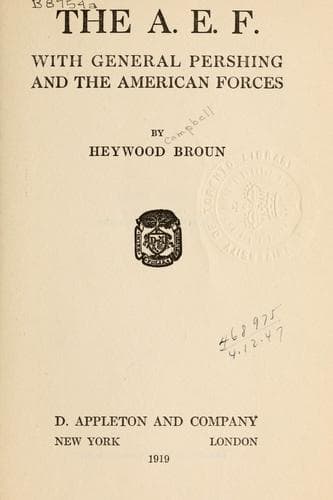
The A. E. F.: With General Pershing and the American ForcesBroun, Heywood
History
The A. E. F.: With General Pershing and the American Forces
Broun, Heywood
United States. Army. American Expeditionary Forces; World War, 1914-1918 -- Personal narratives
The Hindenburg Rathskeller lay to the left of our trench, but it was
only dimly visible through the rain. This battered building was once a
tiny roadside café. Now patrols take shelter behind its walls at night
and try to find cheer in the room where only a few broken bottles
remain. The poilus maintain that on dark nights the ghosts of cognac, of
burgundy and even champagne flit about in and out of the broken windows
and that a lucky soldier may sometimes detect, by an inner warmth and
tingle, the ghost of some drink that is gone. Sometimes it is a German
patrol which spends the night in No Man's Café. It is more or less a
custom to allow whichever side gets to the café first to hold it for the
night, since it is a strong defensive position in the dark. The night
before our visit an American patrol reached the café and found that the
Germans who had been there the night before had placed above the
shattered door of the little inn a sign which read: "Hindenburg
Rathskeller." Silently but swiftly one of the doughboys scratched out
the name with a pencil and left a sign of his own. When next the Germans
came they found that Hindenburg Rathskeller had become the Baltimore
Dairy Lunch.
Several hundred yards behind the Baltimore Dairy Lunch is another ruined
house and it was here that the Americans killed their first German. Even
on clear days Germans in groups of not more than two would sometimes
come from their trenches to the house. The French thought that they had
a machine gun there, but it was not worth while to waste shells on
parties of one or two and as the range was almost 1700 yards the Germans
felt comparatively immune from rifle fire. Two doughboys saw a German
walking along the road one bright morning and as they had telescopic
sights on their rifles they were anxious to try a shot. One of the men
was a sergeant and the other a corporal.
"That's my German," said the sergeant.
"I saw him first," objected the corporal, and so they agreed to count
five and then fire together. One or both of them hit him, for down he
came.
When we got back to the second line the men were having supper. The food
supplied to the soldiers in the trenches was hot and adequate and
moderately abundant. A few of the men complained that they got only two
meals a day, but I found that there was an early ration of coffee and
bread which these soldiers did not count as enough of a breakfast to be
mentioned as a meal. This comes at dawn and then there are meals at
about eleven and five. One of the men with whom I talked was mournful.
Public-domain text, read in full here on John Shaqi.
Reviews
Reviews
No reviews yet
Be the first to share your thoughts on this work.
Elsewhere in the archive
Join the Discussion
Join the discussion
Sign in to leave a comment or review.
Sign InorCreate an account