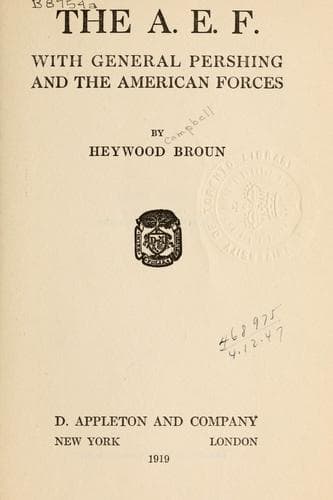
The A. E. F.: With General Pershing and the American ForcesBroun, Heywood
History
The A. E. F.: With General Pershing and the American Forces
Broun, Heywood
United States. Army. American Expeditionary Forces; World War, 1914-1918 -- Personal narratives
The name for the American soldiers gave the French press and public no
end of trouble. They began enthusiastically enough by calling them the
"Teddies," but General Pershing, when interviewed one day, said that he
did not think this name quite fitting as it had "no national
significance." The French then followed the suggestion of one of the
American correspondents and began to call the soldiers "Sammies," or as
the French pronounce it, "Sammees." Although this name received much
attention in French and American newspapers it has never caught the
fancy of the soldiers in the American Expeditionary Army. Officers and
men cordially despise it and no soldier ever refers to himself or a
comrade as a "Sammy." American officers have not been unmindful of the
usefulness of a name for our soldiers. Major General Sibert, who
commanded the first division when it arrived in France, posted a notice
at headquarters which read: "The English soldier is called Tommy. The
French soldier is called poilu. The Commanding General would like
suggestions for a name for the American soldier." At the end of the week
the following names had been written in answer to the General's request:
"Yank, Yankee, Johnnie, Johnny Yank, Broncho, Nephew, Gringo, Liberty
Boy, Doughboy."
Now Doughboy is a name which the soldiers use, but strictly speaking, it
refers only to an infantryman. The origin of the name is shrouded in
mystery. One officer, probably an infantryman, has written, that the
infantrymen are called doughboys because they are the flower of the
army. Another story has it that during some maneuvers in Texas an
artilleryman, comfortably perched on a gun, saw a soldier hiking by in
the thick sticky Texas mud. The mud was up to the shoetops of the
infantryman and the upper part which had dried looked almost white.
"Say," shouted the artilleryman, "what've you been doing? Walking in
dough?" And so the men who march have been doughboys ever since.
Public-domain text, read in full here on John Shaqi.
Reviews
Reviews
No reviews yet
Be the first to share your thoughts on this work.
Join the Discussion
Join the discussion
Sign in to leave a comment or review.
Sign InorCreate an account