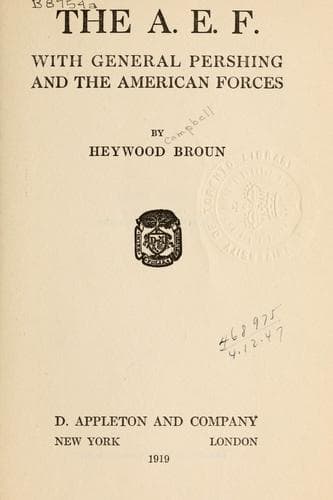
The A. E. F.: With General Pershing and the American Forces — John Shaqi
The A. E. F.: With General Pershing and the American ForcesBroun, Heywood
History
The A. E. F.: With General Pershing and the American Forces
Broun, Heywood
United States. Army. American Expeditionary Forces; World War, 1914-1918 -- Personal narratives
One of the men in the crowd which watched the batting practice was a
French soldier headed back for the front. At any rate he had his steel
helmet on and his equipment was on his back. His stripes showed that he
had been in the war three years and he had the croix de guerre with two
palms and the medaille militaire. His interest in the game grew so high
at last that he put down his pack and his helmet and joined the
outfielders. The second or third ball hit came in his direction. He ran
about in a short circle under the descending ball and at the last moment
he thrust both hands in front of his face. The ball came between them
and hit him in the nose, knocking him down.
His nose was a little bloody, but he was up in an instant grinning. He
left the field to pick up his trench hat and his equipment. The
Americans shouted to him to come back. He understood the drift of their
invitation, but he shook his head. "C'est dangéreux," he said, and
started for the station to catch his train for the front.
CHAPTER V
WITHIN SOUND OF THE GUNS
The men had traveled to Paris in passenger coaches, but when it came
time to move the first division to its training area in the Vosges our
soldiers rode like all the other allied armies in the famous cars upon
which are painted "Hommes 36; chevaux en long, 8." And, of course,
anybody who knows French understands the caption to mean that the horses
must be put in lengthwise and not folded. No restrictions are mentioned
as to the method of packing the "hommes."
The journey lay through gorgeous rolling country which was all a sparkle
at this season of the year. Presently the vineyards were left behind and
the hills became higher. Now and again there were fringes of pine trees.
At one point it was possible to see a French captive balloon floating
just beyond the hilltops, but we could not hear the guns yet. French
soldiers in troop trains and camps near the track cheered the Americans
and even a few of the Germans inside a big stockade waved at the men who
were moving forward to study war. The trains stopped at a little town
which lay at the foot of a hill. It was a mean little town, but on the
hill was the fine old tower of a castle which had once dominated the
surrounding country.
From this town, which was chosen as divisional headquarters, regiments
were sent northeast and northwest into tiny villages which were no more
than a single line of houses along the roadway. A few one-story wooden
barracks had been built for the Americans, but ninety per cent. of the
men went into billets. They were quartered in the lofts of barns of the
better sort. The billeting officers would not consider sheds where
cattle had been kept. Few troops had been quartered in this part of the
country previously and so the barns were moderately clean.
Public-domain text, read in full here on John Shaqi.
Reviews
Reviews
No reviews yet
Be the first to share your thoughts on this work.
Join the Discussion
Join the discussion
Sign in to leave a comment or review.
Sign InorCreate an account