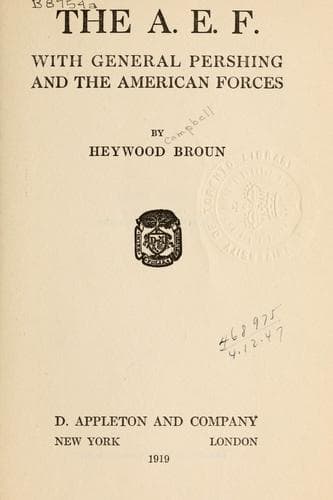
The A. E. F.: With General Pershing and the American ForcesBroun, Heywood
History
The A. E. F.: With General Pershing and the American Forces
Broun, Heywood
United States. Army. American Expeditionary Forces; World War, 1914-1918 -- Personal narratives
The effort to make cleanliness and sanitation something more than
relative terms was the first thing which really threatened
Franco-American amity. The decision of American officers that all manure
piles must be removed from in front of dwelling houses met a startled
and universal protest. Elderly Frenchwomen explained with great feeling
that the manure piles had been there as long as they could remember and
that no one had ever come to any harm from them. The American officers
insisted, and at last a grudging consent was forced. I saw one old lady
almost on the point of tears as she watched the invaders demolish her
manure pile. At last she could stand no more. "They make a lot of dust,"
she said critically, and went into the house.
A few days after the Americans arrived in camp came their instructors. A
crack division of Alpine Chasseurs was chosen to teach the Americans.
Nobody called these men froggies. They called them "chassers." It was
enough to see them march to know that they were fighting men. Their
stride was short and quick. Each step was taken as if the marcher was
eager to have it over and done with so that he could take another. Even
their buglers won admiration, for they had a trick of throwing their
instruments in the air and catching them again that brought envy to the
heart of every American band. Indeed, a good deal of friendly rivalry
developed from the beginning and in the early days, at least, the French
had all the better of it. They could lift heavier weights than our men,
who averaged much younger. Little Frenchmen standing five feet three or
four would seize a rifle close to the end of the bayonet and slowly
raise it with stiff arm to horizontal and down again. American farmer
boys tried and failed. Of course, this was a crack French division which
drew its men from various organizations, while our division was just the
average lot and perhaps not quite that since there was a larger
percentage of recruits than is usually found in the regular army.
Public-domain text, read in full here on John Shaqi.
Reviews
Reviews
No reviews yet
Be the first to share your thoughts on this work.
Join the Discussion
Join the discussion
Sign in to leave a comment or review.
Sign InorCreate an account