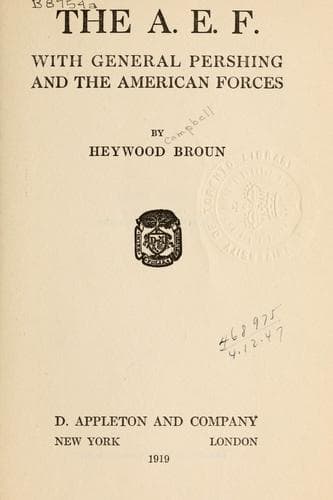
The A. E. F.: With General Pershing and the American ForcesBroun, Heywood
History
The A. E. F.: With General Pershing and the American Forces
Broun, Heywood
United States. Army. American Expeditionary Forces; World War, 1914-1918 -- Personal narratives
The second week in the training area found the doughboys increasing
their curriculum to include bombs and machine guns. It had not been
possible to do much in the finer arts of war previously because of the
absence of interpreters. A number of these had been mobilized now but
they varied in quality. As one American officer put it, "Interpreters
may be divided into three classes: those who know no English; those who
know no French; and those who know neither."
However, the Americans managed to get their instruction in some way or
other. No interpreters were needed with the machine guns. Instead each
American company was divided up into little groups and a chasseur placed
at the head of each group. I watched the instruction and found that
little language was needed. The Frenchman would take a machine gun or
automatic rifle apart and holding up each part give its French name. The
Americans paid no particular attention to the outlandish terms which the
French used for their machine gun parts, but they were alert to notice
the manner in which the gun was put together and in the group in which I
was standing two Americans were able to put the gun together without
having any parts left over after a single demonstration.
Of course, a little language was used. Some of the marines had picked up
a little very villainous French in Hayti and they made what shift they
could with that. A few French Canadians and an occasional man from New
Orleans could converse with the chasseurs and one or two phrases had
been acquired by men hitherto entirely ignorant of French.
"Qu'est-ce-que c'est?" was used by the purists as their form of
interrogation, but there were others who tried to make "combien" do the
work. "Combien," which we pronounced "come bean," was stretched for many
purposes. I have heard it used and accepted as an equivalent for
"whereabouts," "what did you say," "why," "which one" and "will you
please show us once more how to put that machine gun together."
Not only did the Americans show an aptitude for getting the hang of the
mechanism of the machine gun and the automatic rifle, but they shot well
with them after a little bit of practice.
The first man I watched at work with the automatic rifle was green. He
had taken the gun apart and put it together again with an occasional
"regardez" and bit of demonstration from one of the Frenchmen, but the
weapon was not yet his pal. He picked the gun up somewhat gingerly and
aimed at the line of targets a couple of hundred yards away. Then he
pulled the trigger and the bucking thing, which seemed to be intent on
wriggling out of his arms, sprayed the top of the hill with bullets. The
French instructor made a laughing comment and an American who spoke the
language explained, "He says you ought to be in the anti-aircraft
service."
Public-domain text, read in full here on John Shaqi.
Reviews
Reviews
No reviews yet
Be the first to share your thoughts on this work.
Join the Discussion
Join the discussion
Sign in to leave a comment or review.
Sign InorCreate an account