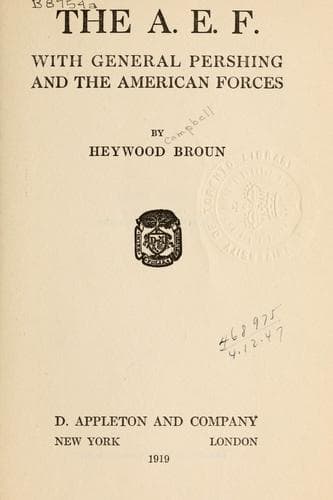
The A. E. F.: With General Pershing and the American ForcesBroun, Heywood
History
The A. E. F.: With General Pershing and the American Forces
Broun, Heywood
United States. Army. American Expeditionary Forces; World War, 1914-1918 -- Personal narratives
The next man to try his luck was a non-commissioned officer long in the
army. He patted the gun and wooed it a little in whispers before he
shot. It was a French gun, to be sure, but the language of firearms is
international. "Behave, Betsy," he said and she did. He sprayed shots
along the line of targets at the bottom of the hill as the gun clattered
away with all the clamor of a riveting machine at seven in the morning.
When they looked at the targets they found he had scored thirty hits out
of thirty-four and some were bull's-eyes. The French instructor was so
pleased that he stepped forward as if to hug the ancient sergeant but
the veteran's look of horror dissuaded him.
Bombing proved the most popular part of training and particularly as
soon as it was possible to work with the live article. First of all
dummy bombs were issued. A French officer carefully explained that the
bomb should be thrown after four moves, counting one, two, three, four,
as he posed something like a shot putter before he let the bomb go with
an overhand, stiff, armed fling. He illustrated the method several
times, but the first American to throw sent the bomb spinning out on a
line just as if he were hurrying a throw to first from deep short. The
Frenchman reproved him and explained carefully that, although it might
be possible to throw a bomb a long way in the manner in which a baseball
is thrown, it was necessary for a bomber to hurl many missiles and that
he must preserve his arm. He also pointed out that the bomb would never
land in the trenches of the enemy unless it was thrown with a
considerable arc.
The men then kept to the exercises laid down by the instructor, but just
before they stopped one or two could not resist the temptation of again
"putting something on to it" and letting the bomb sail out fast. One
lefthander who had pitched for a season in the Southern League was
anxious to make some experiments to see if he couldn't throw a bomb with
an out curve but he was informed that such an accomplishment would have
no military utility.
The first American wounded in France was the victim of a bombing
accident. A soldier threw a live bomb more than thirty meters from a
trench. When the bomb burst a fragment came whirling back in some
curious manner and fell into a box of grenades upon which a lieutenant
was sitting. The fragment cut the pin of one of the bombs and the whole
box went off with a bang. The lieutenant received only a slight cut on
his forehead, but a French interpreter thirty yards away was knocked
unconscious and lost the sight of his right eye. This Frenchman had
spent two years under fire at Verdun without being scratched and here
was his first wound come upon him on a quiet afternoon in a meadow miles
from the lines.
Public-domain text, read in full here on John Shaqi.
Reviews
Reviews
No reviews yet
Be the first to share your thoughts on this work.
Join the Discussion
Join the discussion
Sign in to leave a comment or review.
Sign InorCreate an account