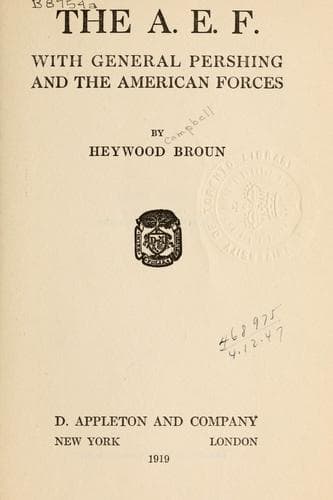
The A. E. F.: With General Pershing and the American ForcesBroun, Heywood
History
The A. E. F.: With General Pershing and the American Forces
Broun, Heywood
United States. Army. American Expeditionary Forces; World War, 1914-1918 -- Personal narratives
The men threw bombs from deep trenches and they were instructed to keep
cover closely after hurling a grenade just as if there was a German
trench across the way. But curiosity was too strong for them. Each
wanted to see where his particular bomb hit and how much earth it would
tear up. The bombs made only small scars in the earth, but they sent
fragments of steel casing flying in all directions and several men were
cut about the face by splinters.
The seeming inability of the American to visualize battle conditions in
training retards his progress in spite of his aptitude in other
directions. A French officer was directing a platoon of Americans one
day in skirmishing. They were to fire a round, run forward twenty paces,
throw themselves flat and run forward again. One doughboy would raise
himself up on his elbows and look about. The Frenchman, very much
excited, ran over to him and said, "You must keep your head down or you
will get shot. You must remember that bullets are flying all about you."
As soon as the instructor's back was turned the soldier was up on his
elbows again. "Hell," he said, "there ain't any bullets."
In later phases of training the inferiority of the American to the
French in imagination showed clearly. French veterans or recruits for
that matter could work themselves up to a frenzy in sham battles and
dash into an empty trench with a shout as if it were filled with
Germans. Americans could not do that. They found it difficult to forget
that practice was just practice.
CHAPTER VI
SUNNY FRANCE
Later on "Sunny France" became a mocking byword uttered by wet and muddy
men, but during the early days in the training area no one had any just
complaint about the weather. Come to think of it there wasn't anything
very wrong with those early days in rural France. Five o'clock was
pretty early for getting up but the sun could do it and keep cheerful.
It was glorious country with hills and forests and plowed fields and red
roofed villages and smooth white roads. The country people didn't throw
their hats in the air like Parisians, but they were kindly though calm.
"Down in ----," said a little doughboy who came from an Indiana farm,
"everybody you meet says 'bon jour' to you whether they know you or not.
That means 'good morning.' I was in Chicago once and they don't do it
there."
It wasn't Eden though. There was the tobacco situation against that
theory. To a good many soldiers, pleasant weather and kindly folk and
ample rations meant nothing much. These were minor things. The
quartermaster had no Bull Durham. When the supply of American tobacco
and cigarettes ran out the men tried the French products but not for
long. "So they call these Grenades," muttered a soldier as he examined a
popular French brand of cigarettes, "I guess that's because you'd better
throw 'em away right after you set 'em going."
Public-domain text, read in full here on John Shaqi.
Reviews
Reviews
No reviews yet
Be the first to share your thoughts on this work.
Join the Discussion
Join the discussion
Sign in to leave a comment or review.
Sign InorCreate an account