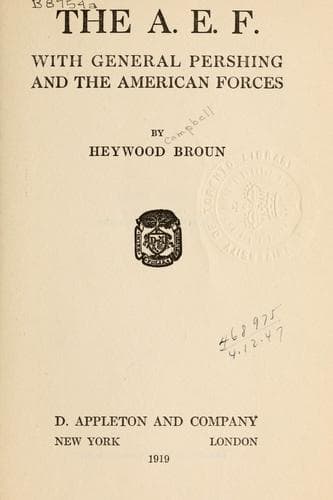
The A. E. F.: With General Pershing and the American Forces — John Shaqi
The A. E. F.: With General Pershing and the American ForcesBroun, Heywood
History
The A. E. F.: With General Pershing and the American Forces
Broun, Heywood
United States. Army. American Expeditionary Forces; World War, 1914-1918 -- Personal narratives
There was some excessive drinking when the army first came to France but
it has been checked. A number of influences have made for discretion.
One of the most potent is the opportunity for promotion in an army in
the field. Officers have been quick to point this out to their men. One
captain called his company together in the early days and said, "Some of
the men in this company are going out and getting pinko, stinko, sloppy
drunk. Any man who gets drunk goes in the guard house of course and more
than that he will get no promotion from me. I'm going to pick my
sergeants from the fellows that have got sense. You may notice that some
of the men who drink are old soldiers. Don't take an example from that.
Remember that's why they're old soldiers. There isn't any sense in
blowing all your money in for booze. Now if I took my pay in a lump at
the end of a month I could buy every café in this town and I could stay
drunk for a year. That would be fine business, wouldn't it?"
"I guess maybe I exaggerated a little about the length of time I could
stay drunk," the captain told me afterwards, "but do you know that talk
seems to have done the trick."
One factor which worked for temperance was the French fashion of making
drinking deliberate and social. When an American can be induced to sit
down to his potion he is comparatively safe. These little village cafés
did no harm after the first brief period when the American soldier had
his fling and they served the good purpose of encouraging fraternization
between doughboy and poilu.
The contact with French soldiers brought no great vocabulary to our men
but if they learned few words they did get the hang of making their
wants understood. In a week or two innkeepers or women in shops had no
trouble at all in attending to the wants of Americans. Probably the
French people made somewhat faster linguistic progress than the
soldiers. The Americans were willing to be met at least halfway. When I
asked one doughboy, "How do you get along with the French? Can you make
them understand you?" he said, "Why, they're coming along pretty well. I
think most of 'em will pick it up in time."
Public-domain text, read in full here on John Shaqi.
Reviews
Reviews
No reviews yet
Be the first to share your thoughts on this work.
Join the Discussion
Join the discussion
Sign in to leave a comment or review.
Sign InorCreate an account