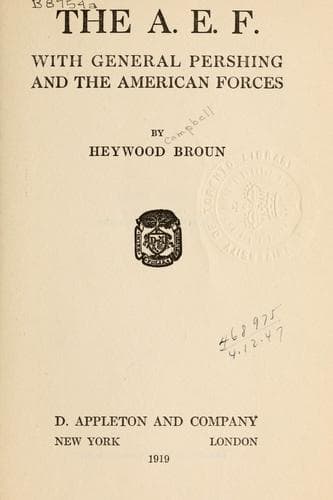
The A. E. F.: With General Pershing and the American ForcesBroun, Heywood
History
The A. E. F.: With General Pershing and the American Forces
Broun, Heywood
United States. Army. American Expeditionary Forces; World War, 1914-1918 -- Personal narratives
But there was one French word the soldiers had to learn. That was
"fineesh." The children forced that word upon them. They were always at
the heels of the American soldiers. They galloped the doughboys up and
down the village streets in furious piggyback charges. They borrowed jam
from company cooks and rode in the supply trucks. Of course there had to
be an end to the rides, sometimes, and even to the jam and the only way
to convince the children of France that an absolute unshakable limit had
been reached was to thrust two hands aloft and cry "fineesh." The old
women liked the doughboys too because they would draw water from the
wells for them and occasionally lend a hand in moving wood or wheat or
fodder. Nor do I mean to imply that the younger women of the little
villages did not esteem the doughboys. "Tell 'em back home that there
aren't any good looking women in France," was the message that ever so
many soldiers asked me to convey to anxious individuals in America. I
hand the message on but must refuse to pass upon its sincerity.
American officers got along well with the French but they never reached
the same degree of chumminess that the men did. They met French officers
at more or less formal luncheons and had to go through a routine of
speeches largely concerned with Lafayette and Rochambeau and Washington.
Poilus and doughboys did not go so far back for their subjects of
conversation. The American enlisted man had a great advantage over his
officer in the matter of language. He might know less French, but he was
much more ready to experiment. An officer did not like to make mistakes.
His was defensive French, a weapon to be used guardedly in cases of
extreme need. When a visiting officer hurled a compliment at him he
replied, but he seldom took the initiative. After all he was an American
officer and he feared to make himself ridiculous by poor pronunciation
and worse grammar. The soldier had no such scruples. He saw no reason
why he should be any more abashed by French grammar than by English and
as for pronunciation he followed the advice of a little pamphlet called
"The American in France" which was rushed out by some French firm for
sale to the American army. In the matter of pronunciation the book said,
"Since pronunciation is the most difficult part of any language the
publishers of this book have decided to omit it." The soldiers were
ready to adopt this method and only wished that it could be extended to
other things. To trench digging for instance.
Public-domain text, read in full here on John Shaqi.
Reviews
Reviews
No reviews yet
Be the first to share your thoughts on this work.
Join the Discussion
Join the discussion
Sign in to leave a comment or review.
Sign InorCreate an account