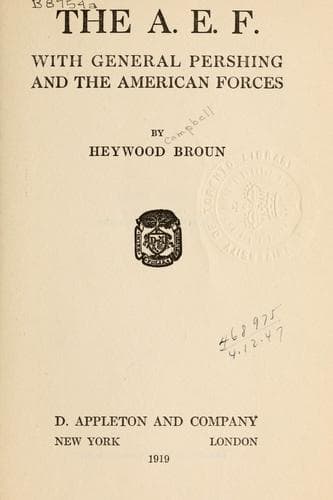
The A. E. F.: With General Pershing and the American Forces — John Shaqi
The A. E. F.: With General Pershing and the American ForcesBroun, Heywood
History
The A. E. F.: With General Pershing and the American Forces
Broun, Heywood
United States. Army. American Expeditionary Forces; World War, 1914-1918 -- Personal narratives
The most daring man in the use of an unfamiliar language was not a
soldier but a second lieutenant. He took great pride in his talent for
pantomime and asserted that his vocabulary of some thirty words and his
gestures filled all his needs. He was somewhat startled though on an
afternoon when he went into a shop to purchase "B.V.D.'s" and found the
store in charge of the young daughter of the proprietor. Pantomime
seemed hardly the thing and so he paused long to think up a word for the
garment he wanted or some approximation. At last he smiled and exclaimed
brightly, "Chemise pour jambes, s'il vous plait."
Stores were not the strong point of our bit of France. We soon came to
regard our town as a metropolis because people journeyed there to make
"shopping tours." One afternoon I marked fifteen visiting soldiers with
their eyes glued against a shop window which displayed half a dozen
electric flashlights, two quarts of champagne, a French-English
dictionary and a limited assortment of postcards. These, of course, were
barred from the mail by censorship but the soldiers collected them to be
taken home after the war.
"These French postcards aren't exactly what some of the boys back home
are going to expect," one soldier admitted. "I went to three shops now
but the others have been ahead of me and all I could get was these two.
One's a picture called 'l'eglise' and the other's 'la maison de Jeanne
d'Arc.'"
The shops had hard work in keeping up with more commodities than picture
postcards. There seemed to be an insatiable demand for canned peaches
and sardines. Somehow or other men who have been on a long march simply
crave either sardines or canned peaches. The doughboys did a good deal
of eating at their own expense. Army food was plentiful and moderately
varied. Beans and corned beef hash were served a good many times
perhaps, but there was no lack of fresh meat and there was plenty of jam
and of carrots and onions and heavy gravy. Food, however, was an outlet
for spending money and in some villages the men got so eager that they
would buy anything. Little traveling shops in wagons came through the
smaller villages in the northern part of the training area loaded with
all sorts of gimcracks intended for the peasant trade. The peddlers had
no time to put in a special line for the soldiers. They found that it
was not necessary. Desperate men with pockets full of money would
purchase even the imitation tortoise shell sidecombs which the itinerant
merchants had to sell.
Public-domain text, read in full here on John Shaqi.
Reviews
Reviews
No reviews yet
Be the first to share your thoughts on this work.
Join the Discussion
Join the discussion
Sign in to leave a comment or review.
Sign InorCreate an account