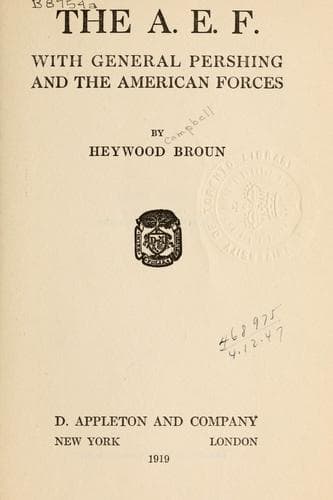
The A. E. F.: With General Pershing and the American ForcesBroun, Heywood
History
The A. E. F.: With General Pershing and the American Forces
Broun, Heywood
United States. Army. American Expeditionary Forces; World War, 1914-1918 -- Personal narratives
"I shall have time tables made for the men on leave," he said and then
for an instant he became the shrewd French business man rather than the
dashing general.
"I have figured out," he explained, "that the army can afford to sell
these time tables for five sous. It wouldn't do to give them away.
Nobody would value them then."
A week later we had another visitor. French generals and all their
resplendent aides clicked their heels together and stood at attention as
this civilian passed by. He was a short stoutish man in blue serge
knickerbockers and a dark yachting cap. His tailor deserved no
decoration for this seemed a secondary sort of costume and headgear in a
group loaded down with gold braid and valor medals. But their swords
flashed for the man in the yachting cap and a great general saw him into
his car, for the stoutish visitor was the President of the French
Republic. Generals Pétain and Pershing accompanied Poincaré in his car
up to the drill ground. It was an American division which marched this
morning. In fact it was the same unit which had marched through the
streets of the port only a few months before. They had grown browner and
straighter since that day and they looked taller. Group consciousness
had dawned in them now. The only lack of discipline was shown by the
mules. It must be admitted that the mule morale left much to be desired.
Many were new to the task of dragging machine guns and those that did
not sulk tried to run away. Strong arms and stronger words prevailed
upon them.
"Remember," the driver would plead, "you have a part in making the world
safe for democracy," and in a trice all the evil would flee from the
eyes and the heels of the unruly animals.
A number of bands helped to keep the men swinging into the face of a
driving rain. The French officers who accompanied Pétain and Poincaré
were somewhat surprised when one regiment went by to the tune of
"Tannenbaum," but General Pershing explained that it had been played in
America for years under the name of "Maryland, My Maryland." He had a
harder task some minutes later when a band struck up a regimental hymn
called "Happy Heinie," which borrows largely from "Die Wacht am Rhein"
for its chorus.
Public-domain text, read in full here on John Shaqi.
Reviews
Reviews
No reviews yet
Be the first to share your thoughts on this work.
Join the Discussion
Join the discussion
Sign in to leave a comment or review.
Sign InorCreate an account