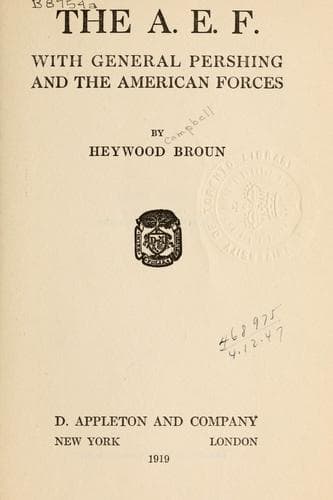
The A. E. F.: With General Pershing and the American ForcesBroun, Heywood
History
The A. E. F.: With General Pershing and the American Forces
Broun, Heywood
United States. Army. American Expeditionary Forces; World War, 1914-1918 -- Personal narratives
As soon as the troops marched by, General Pershing sent orders for all
the officers to assemble. They gathered in a great half circle before
the French President who spoke to them slowly and with much earnestness.
Indeed, he spoke so slowly that fair scholars could follow his
discourse. Even those who could grasp no more than such words as
"Lafayette" and "President Wilson" and "la guerre" listened with
apparent interest. M. Poincaré called attention to the fact that the day
was the anniversary of the Battle of the Marne and also the birthday of
Lafayette. These days, he said, linked together the two nations which
were making a common cause in the struggle for civilization and he ended
with a dramatic sweep of his arm as he exclaimed, "Long live the free
United States." However, he called it Les Etats Unis which made it more
difficult.
"What did he say?" a group of doughboys asked a sergeant chauffeur who
had been stationed near enough to hear the speech. "I didn't get it
all," said the sergeant, "but it sounded a good deal like 'give 'em
hell.'"
The President and his party spent the rest of the afternoon inspecting
the billets of the Americans. In one barn Poincaré insisted on climbing
up a ladder to see the quarters at close range and as he climbed slowly
and clumsily it came to my mind that the presidential waist line, the
knickerbockers and the yachting cap were all symbols of the fact that
France even in war was still a civil democracy.
Still it must be admitted that the next civilian we saw was more warlike
than any of the soldiers. The only military equipment worn by Georges
Clemenceau was a pair of leather puttees which didn't quite fit, but he
had eyes and eyebrows and a jaw which all combined to suggest pugnacity.
He was not then premier and indeed he had been in political retirement
for some time, but he made a greater impression on the soldiers than any
of our visitors because he spoke in English. It was on September 16,
1917, that Clemenceau saw American soldiers, but he had seen them once
before and that was in Richmond in 1864 when Grant marched into the
city. Clemenceau was then a school teacher in America. The old Frenchman
watched the sons and grandsons of those dead and gone fighters and
expressed the wish that he might see American troops once again when
they marched into Berlin.
The doughboys he saw in France were not the seasoned troops which swung
by him on those dusty Virginia roads so many years ago, but in their
hands were new weapons which might have turned the tide at Bull Run and
changed Gettysburg from victory into a rout. Certainly Pickett would
have never swept up to the Union lines if there had been machine guns
such as those with which the rookies blistered the targets for the
edification of the distinguished guests and the bombs which sent the
pebbles sky high might have given pause even to Stonewall Jackson.
Public-domain text, read in full here on John Shaqi.
Reviews
Reviews
No reviews yet
Be the first to share your thoughts on this work.
Join the Discussion
Join the discussion
Sign in to leave a comment or review.
Sign InorCreate an account