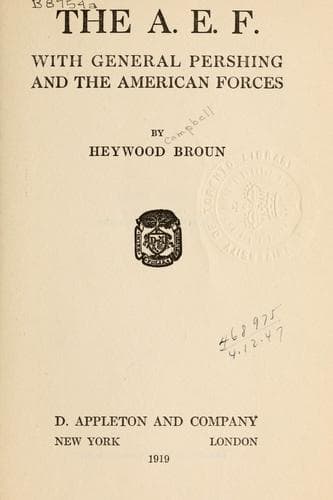
The A. E. F.: With General Pershing and the American Forces — John Shaqi
The A. E. F.: With General Pershing and the American ForcesBroun, Heywood
History
The A. E. F.: With General Pershing and the American Forces
Broun, Heywood
United States. Army. American Expeditionary Forces; World War, 1914-1918 -- Personal narratives
Most of the letters were cheerful. Some courageously so. One man who was
near death from tuberculosis wrote home once a day recounting imaginary
events which had happened outside the walls of his hospital. In his
letters he would send himself on long marches over the hills of France
and describe the woods and meadows and plowed fields as they looked to
him on bright mornings. He described in detail work which he was doing
in bombing and the only complaint he ever made was on a day when he had
coughed himself to such weakness that he could hardly finish his daily
letter. He wrote to his mother then and asked her to excuse the
briefness of his note. He explained that he was pretty well fagged out
from a long afternoon of bayonet drill.
The soldiers frequently commented on the kindliness of the French people
and they were also fond of boasting, with perhaps doubtful
justification, that they were already proficient in the French language.
A few were desirous of giving the folk back home a thrill. One man
working as company cook at a port in France, some three or four hundred
miles from the firing line, wrote a weekly letter describing all sorts
of war activities. He made up air raids and heavy bombardments and
fairly tore up the village in which he was living. Curiously enough he
never made himself conspicuous in these actions. According to the
letters he was just there with the rest taking the "strafing" as best he
could.
The officer who censored his first warlike letter cut out all the
imaginative flights, but two days later the soldier wrote another letter
even more thrilling. He complained that it was difficult to write
because the explosion of big shells nearby made the house rock.
The lieutenant called him up then and said, "You're writing a lot of
lies home, aren't you?"
"Yes, sir," said the soldier.
"Well, what are you doing it for?" continued the officer.
The soldier shifted about in embarrassment and then he said, "Well, you
see, sir, those letters are to my father. He went into the Union army
when he was sixteen and fought all through the last two years of the
war. He lives in a little town in Ohio and the people there call him
'Fighting Bill' on account of what he did in the Civil War. Well, when I
went away to this war he began to go round town and tell everybody that
I was going to do fighting that would make 'em all forget about the
Civil War. He used to say that I came of fighting stock and that I'd
make 'em sit up and take notice. It would be pretty tough for him, sir,
if I had to write home and say that I was cooking down in a town where
you can't even hear the guns."
"That's all right," said the lieutenant, "but some of the people who've
got sons in this regiment will be doing a lot of worrying long before
they have any need to."
"No, sir," said the soldier, "my father don't know what regiment I'm
with. I was transferred when I got over here and the only address he's
got is the military post office number."
Public-domain text, read in full here on John Shaqi.
Reviews
Reviews
No reviews yet
Be the first to share your thoughts on this work.
Join the Discussion
Join the discussion
Sign in to leave a comment or review.
Sign InorCreate an account