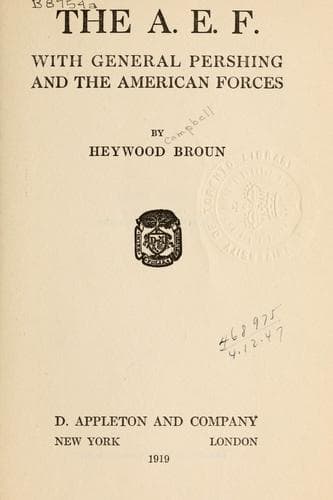
The A. E. F.: With General Pershing and the American ForcesBroun, Heywood
History
The A. E. F.: With General Pershing and the American Forces
Broun, Heywood
United States. Army. American Expeditionary Forces; World War, 1914-1918 -- Personal narratives
"I don't know what to say in that case," replied the lieutenant. "It's a
cinch you're not giving away any military information and I can't see
how you're giving, any aid and comfort to the enemy. I guess you can go
on with that battle stuff. Make the bombardments just as hard as you
like, but keep the casualties light."
In contrast to the attitude of the veteran back in Ohio was a letter
which a captain received from the mother of one of his men.
"My son is only nineteen," she wrote. "He has never been away from home
before and it breaks my heart that he should be in France. It may sound
foolish but I want to ask you a favor. When he was a little boy I used
to let him come into the kitchen and bake himself little cakes. I think
he would remember some of that still. Can't you use him in the bakery or
the kitchen or some place so he won't have to be put in the firing line
or in the trenches? I will pray for you, captain, and I pray to God we
may have peace for all the world soon."
The captain read the letter and then he burned it up. "If the rest of
the men in the company heard of that they would jolly the life out of
that boy," he said. But he sat down and wrote to the mother, "Your boy
is well and I think he is enjoying his work. I cannot promise to do what
you ask because your son is one of the best soldiers in my company. We
are all in this together and must share the dangers. I pray with you
that there may be peace and victory soon."
No complete story of America's part in the war will ever be written
until somebody has made a collection and read thousands of the letters
home. The doughboy is strangely inarticulate. He can't or he won't tell
you how he felt when he first landed in France, or heard the big guns
or went to the trenches. He is afraid to be caught in a sentimental pose
but this fear leaves him when he writes. In his letters he will pose at
times. This is not uncommon. Many a man who would never think of saving
anything about "saving France" will write about it in rounded sentences.
His deepest and frankest thoughts will come out in letters.
Of course the censors stand between these makers of history and
posterity. We must wait for our chronicles of the war because of the
censor. The newspaper stories about our troops in France on their
tremendous errand should ring like the chronicle of an old crusade, but
it is hard for the chronicler to bring a tingle when he must write or
cable "Richard the deleted hearted."
When a censor wants to kill a story he usually says, "Don't you know
that your story may possibly give information to the Germans?" The
correspondent then withdraws his story in confusion. Of course what he
should answer is, "Very well, that story may give information to the
Germans, but it will also give information to the Americans and just
now that is much more important."
Public-domain text, read in full here on John Shaqi.
Reviews
Reviews
No reviews yet
Be the first to share your thoughts on this work.
Join the Discussion
Join the discussion
Sign in to leave a comment or review.
Sign InorCreate an account