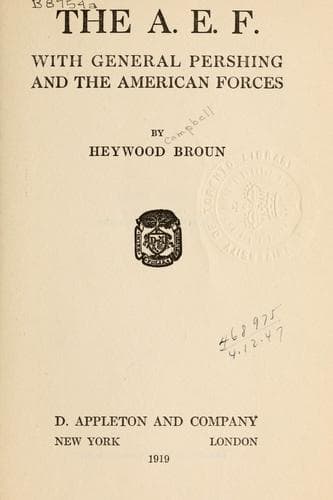
The A. E. F.: With General Pershing and the American ForcesBroun, Heywood
History
The A. E. F.: With General Pershing and the American Forces
Broun, Heywood
United States. Army. American Expeditionary Forces; World War, 1914-1918 -- Personal narratives
It is largely accidental. For instance, when the American troops were
first billeted in the training area the marines were placed at the upper
end of the triangle miles further from the field of divisional maneuvers
than any of their comrades. And so, if Joffre, or Pétain, or
Clemenceau, or Poincaré, or any of the others came to review the first
American expeditionary unit, the marines had to march twenty-two miles
in a day in addition to the ground which they would cover in the review.
Curiously enough, this did not inspire them with a hatred of the
reviews, nor did they complain of their lot. They merely took the
attitude that a few miles more or less made no difference to a marine.
I remember a story a young officer told me about his first hike with the
marines in France. They had eleven miles to do in the morning and as
many more in the afternoon, after a brief review. The young officer
appeared with a pair of light shoes with a flexible sole.
"Look here," said the major, "you'd better put on heavier shoes."
"I think these will suffice, sir," said the young lieutenant. "You see,
they're modeled on the principle of an Indian moccasin--full freedom for
the foot, you know."
The major grinned. "Come around and see me this evening," he said, "and
tell me what you think of the Indians." The man with the moccasin style
shoe did well enough until the company was in sight of the home village.
Unfortunately, a halt was called at a point where a brook ran close to
the road.
The sight of the cool stream made the lieutenant's feet burn and ache
worse than ever. "I had just about made up my mind to turn my men over
to the sergeant and limp home, after a crack at the brook," said the
lieutenant, "when I heard one of the men say that he was tired. There
was an old sergeant on him like a flash. He was one of the oldest men in
the regiment. He had never voted the prohibition ticket and rheumatism
was only one of his ailments, but he hopped right on the kid who said he
was tired. 'Where do you get off to be a marine?' he said. 'Why, we
don't call a hike like this marching in the marines. Look here.' And the
old fellow did a series of jig steps to show that the march was nothing
to him.
"Well," said the young officer, "I didn't turn the men over to the
sergeant and I didn't bathe my feet in the brook. I marched in ahead of
them. You see, I thought to myself, I guess my feet will drop off all
right before I get there, but I can't very well stop. After all, I'm a
marine."
Even the Germans did their best to make the marines feel that they were
troops apart from the others. Only one raid was attempted during the
summer and then it was the village of the marines upon which a bomb was
dropped. It injured no one and did ever so much to increase the pride of
marines, who would remark to less fortunate organizations in the
training area: "What do you know about aeroplanes?"
Public-domain text, read in full here on John Shaqi.
Reviews
Reviews
No reviews yet
Be the first to share your thoughts on this work.
Join the Discussion
Join the discussion
Sign in to leave a comment or review.
Sign InorCreate an account