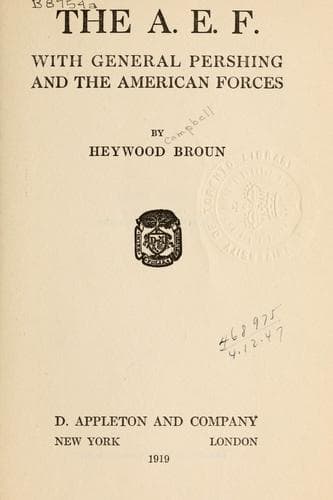
The A. E. F.: With General Pershing and the American ForcesBroun, Heywood
History
The A. E. F.: With General Pershing and the American Forces
Broun, Heywood
United States. Army. American Expeditionary Forces; World War, 1914-1918 -- Personal narratives
The youngster was hazy as to the source of his information, but he never
doubted that it was accurate. He felt sure that the Kaiser had heard of
the marines. Weren't they "first to fight"? And if he didn't fear them
yet, he would. At least he would when Company D got into action.
No unit in the American army today has the group consciousness of the
marines. It is difficult to understand just how this has happened.
Everybody knows that once a regiment, or a division, or even an army,
has acquired a tradition, that tradition will live long after every man
who established it has gone. There is, for instance, the Foreign Legion
of the French army. Thousands and thousands of men have poured through
this organization. Sickness and shrapnel, the exigencies of the service
and what not have swept the veterans away again and again, but it is
still the Foreign Legion. Some of its new recruits will be negro
horseboys who have missed their ships at one of the ports through
overprotracted sprees; there will be a gentleman adventurer or two, and
a fine collection of assorted ruffians. But in a month each will be a
legionary.
I saw an American negro in a village of France who had been a legionary
until a wound had stiffened a knee too much to permit him to engage in
further service. He was a shambling, shuffling, whining, servile negro,
abjectly sure that some kind white gentleman would give him a pair of
shoes, or at least a couple of francs. But he had the Croix de Guerre
and the Medaille Militaire. He had not cringed while he was a legionary.
The tradition of this organization, however, is based on battle service.
The Legion has seen all the hardest fighting. The tradition of our
marines rests on something else. They have seen service, of course, but
it has not been considerable. Their group feeling was at first sheerly
defensive. There was a time when the marine was a friend of no one in
the service. He was neither soldier nor sailor. Many of the marine
officers were men who had been unable to get appointments at West Point
or Annapolis, or, having done so, had failed to hold the pace at the
academies. And so the spirit of the officers and the men was that they
would show the army and the navy of just what stuff a marine was made.
And they have. It is true that the army and the navy have ceased long
since to look down upon the marine, but the pressure of handicap has
been maintained among the marines in France just the same.
Public-domain text, read in full here on John Shaqi.
Reviews
Reviews
No reviews yet
Be the first to share your thoughts on this work.
Join the Discussion
Join the discussion
Sign in to leave a comment or review.
Sign InorCreate an account