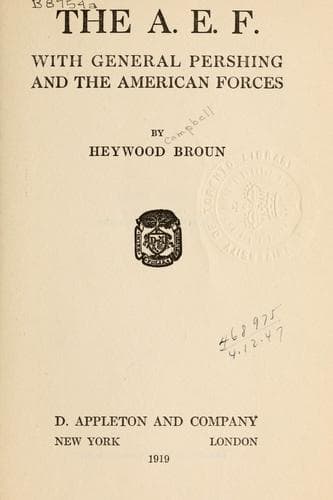
The A. E. F.: With General Pershing and the American ForcesBroun, Heywood
History
The A. E. F.: With General Pershing and the American Forces
Broun, Heywood
United States. Army. American Expeditionary Forces; World War, 1914-1918 -- Personal narratives
The camp consisted of a number of brick barracks and the soldiers and
officers were well housed. It was located in wild country, though, where
it was possible to find ranges up to twelve thousand yards. Scrubby
woods covered part of the ranges and the observation points towered up
a good deal higher than would be safe at the front. We went through the
woods the morning after our arrival and heard a perfect bedlam of fire
from the guns. There was the sharp decisive note of the seventy-five
which speaks quickly and in anger and the more deliberate boom of the
one hundred and fifty-five howitzer. This was a colder note but it was
none the less ominous. It had an air of premeditated wrath about it. The
shell from the seventy-five might get to its destination first but the
one hundred and fifty-five would create more havoc upon arrival. A
sentry warned us to take the left hand road at a fork in the woods and
presently we came upon one of the observation towers. It was crammed
with officers armed with field glasses. Every now and then they would
write things on paper. They seemed like so many reporters at a baseball
game recording hits and errors. When we got to the top of the tower we
found that large maps were part of the equipment as well as field
glasses. These were wonderfully accurate maps with every prominent tree
and church spire and house top indicated. The officers were ranging
from the maps. The French theory of artillery work was not new to the
American officers, but this was almost the first chance they had ever
had to work it out for we have no maps in America suitable for ranging.
According to theory the battery should first fire short and then long
and then split the bracket and land upon the target or thereabouts. The
men had not been working long and they were still a little more
proficient in firing short or long than in splitting the bracket. Later
the American artillery gave a very good account of itself at the school.
The French instructors told one particular battery that they were able
to fire the seventy-five faster than it had ever been fired in France
before. Perhaps there was just a shade of the over-statement of French
politeness in that, but it was without doubt an excellent battery. In
the lulls between fire could be heard the drone of aeroplanes for a
number of officers were flying to learn the principles of aerial
observation in its uses for fire control. Turning around we could also
see a large captive balloon. All the junior officers were allowed to
express a preference as to which branch of artillery work they preferred
and, although observation is the most dangerous of all, fully
seventy-five per cent, of the men indicated it as their choice.
Public-domain text, read in full here on John Shaqi.
Reviews
Reviews
No reviews yet
Be the first to share your thoughts on this work.
Join the Discussion
Join the discussion
Sign in to leave a comment or review.
Sign InorCreate an account