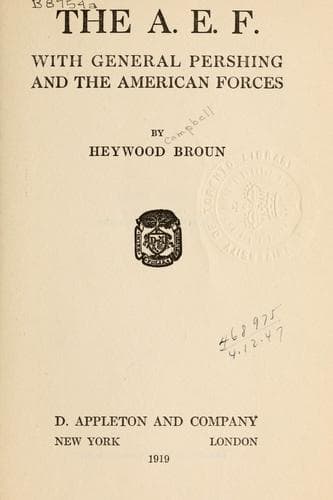
The A. E. F.: With General Pershing and the American ForcesBroun, Heywood
History
The A. E. F.: With General Pershing and the American Forces
Broun, Heywood
United States. Army. American Expeditionary Forces; World War, 1914-1918 -- Personal narratives
Some American officers in other sections of the training area came to
the conclusion in time that we should go to the English for instruction
in some of the phases of modern warfare. We did in fact turn to the
English finally for bayonet instruction and a certain number of officers
thought that the English would also be useful to us in bombing, but I
never heard any question raised but that we must continue to go to the
French for instruction in field artillery until such time as we had
schools of our own.
The difference in language made occasional difficulties of course. "It
took us a couple of days to realize that when our instructor spoke of a
'rangerrang' he meant a 'range error,'" said one American officer, "but
now we get on famously."
We left the men in the tower with their maps and their glasses and went
down to see the guns. Our guide took us straight in front of the one
hundred and fifty-fives while they were firing, which was safe enough as
they were tossing their shells high in the air. It was better fun,
though, to stand behind these big howitzers, for by fixing your eye on a
point well up over the horizon it was possible to see the projectile in
flight. The shell did not seem to be moving very fast once it was
located. It looked for all the world as if the gunners were batting out
flies and this was the baseball which was sailing along.
The French officer who was showing us about said that he could see the
projectile as it left the mouth of the gun, but though the rest of us
tried, we could see nothing but the flash. Later we stood behind the
seventy-fives but since their trajectory is so much lower it is not
possible to see the shell which they fire. They seemed to make more
noise than the bigger guns. Fortunately it is no longer considered bad
form to stick your fingers in your ears when a gun goes off. Most of the
officers and men in this particular battery were as careful to shut out
the sound of the cannon as schoolgirls at a Civil War play. Not only did
they stuff their fingers in their ears, but they stood up on their toes
to lessen the vibration.
Guns have changed, however, since Civil War days. They are no longer
drab. Camouflage has attended to that. The guns we saw were streaked
with red and blue and yellow and orange. They were giddy enough to have
stood as columns in the Purple Poodle or any of the Greenwich Village
restaurants.
Before we left the camp we met Major General Peyton C. March, the new
chief of staff, who was then an artillery officer. We agreed that he was
an able soldier because he told us that he did not believe in
censorship. Regarding one slight phase of the training he bound us to
secrecy, but for the rest he said: "You may say anything you like about
my camp, good or bad. I believe that free and full reports in the
American newspapers are a good thing for our army."
Public-domain text, read in full here on John Shaqi.
Reviews
Reviews
No reviews yet
Be the first to share your thoughts on this work.
Join the Discussion
Join the discussion
Sign in to leave a comment or review.
Sign InorCreate an account