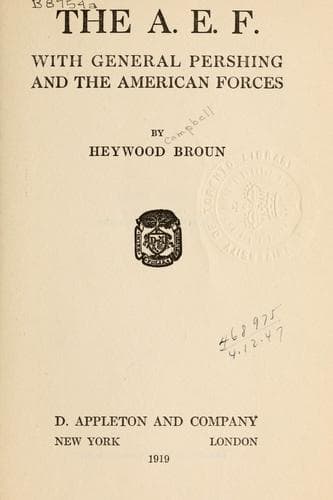
The A. E. F.: With General Pershing and the American ForcesBroun, Heywood
History
The A. E. F.: With General Pershing and the American Forces
Broun, Heywood
United States. Army. American Expeditionary Forces; World War, 1914-1918 -- Personal narratives
We traveled many miles from the field gun school before we came to the
camp of the heavies. This, too, was a French school which had been
partially taken over by the Americans. The work was less interesting
here, for the men were not firing the guns yet, but studying their
mechanism and going through the motions of putting them in action. Many
of the officers attached to the heavies were coast artillerymen and
there was a liberal sprinkling of young reserve officers who had come
over after a little preliminary training at Fortress Monroe. The General
in charge of the camp told us that these new officers would soon be as
good as the best because the most important requirement was a technical
education and these men had all had college scientific training or its
equivalent. Just then they were all at school again cramming with all
the available textbooks about French big guns. They did not need to
depend on textbooks alone, for the camp contained types of most styles
of French artillery.
The pride of the contingent was a monster mounted on railroad trucks. It
fired a projectile weighing 1800 pounds. After the French custom, the
big howitzer had been honored by a name. "Mosquito" was painted on the
carriage in huge green letters.
"We call her mosquito," explained a French officer, "because she
stings."
"Mosquito" had buzzed no less than three hundred times at Verdun, but
she had a number of stings left. The Americans detailed with the gun
were loud in its praises and asserted that it was the finest weapon in
the world. There were other guns, though, which had their partisans.
Some swore by "Petite Lulu," a squat howitzer, which could throw a shell
high enough to clear Pike's Peak and still have something to spare.
There were champions also of "Gaby," a long nosed creature which
outranged all the rest. Marcel could talk a little faster than any gun
in camp, but her words carried less weight.
All the menial work about the camp was done by German prisoners. I was
walking through the camp one day when I saw a little tow-headed soldier
sitting at the doorstep of his barracks watching a file of Germans
shuffle by. They were men who had started to war with guns on their
shoulders, but now they carried brooms.
"Do you ever speak to the German prisoners?" I asked the soldier.
"Oh, yes," said the youngster; "some of them speak English, and they say
'Hello' to me and I say 'Hello' back to them. I feel sorry for them."
The little soldier looked at the shabby procession again and then he
leaned over to me confidentially and said with great earnestness as if
he had made up the phrase on the spot: "You know I have no quarrel with
the German people."
Public-domain text, read in full here on John Shaqi.
Reviews
Reviews
No reviews yet
Be the first to share your thoughts on this work.
Join the Discussion
Join the discussion
Sign in to leave a comment or review.
Sign InorCreate an account