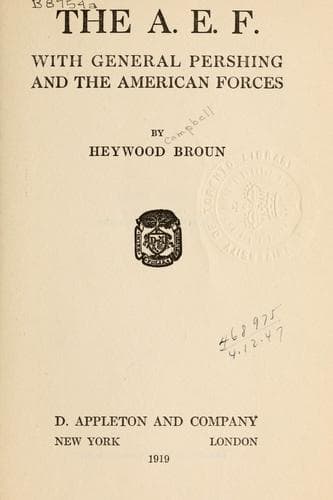
The A. E. F.: With General Pershing and the American ForcesBroun, Heywood
History
The A. E. F.: With General Pershing and the American Forces
Broun, Heywood
United States. Army. American Expeditionary Forces; World War, 1914-1918 -- Personal narratives
We saw a good deal of the British army during our trip but the thing
which gave me the clearest insight into the fundamental fighting,
sporting spirit of the army was a story which an officer told me of an
incident which occurred in the sector where he was stationed. An
enlisted man and an officer were trapped during a daylight patrol when a
mist lifted and they had to take shelter in a shell hole. They lay there
for some hours, and then the soldier endeavored to make a break back for
his own trenches. No sooner had his head and shoulders appeared above
the shell hole than a German machine gun pattered away at him. He was
hit and the officer started to climb up to his assistance.
"No, don't come," said the soldier. "They got me, sir." He put his hand
up and indicated a wound on the left hand side of his chest. "It was a
damn good shot," he said.
CHAPTER XVII
BACK FROM PRISON
France has a better right to fight than any nation in the world because
she can wage war, even a slow and bitter war, with a gesture. Misery
does not blind the French to the dramatic. Even the tears and the
heartache are made to count for France. We saw wounded men come back
from German prison camps and Lyons made the coming of these wrecked and
shattered soldiers a pageant. Gray men, grim men, silent men stood up
and shouted like boys in the bleachers because there was someone there
to greet them with the right word. There is always somebody in France
who has that word.
This time it was a lieutenant colonel of artillery. He was a man big as
Jess Willard and his voice boomed through the station like one of his
own huge howitzers as he swung his arm above his head and said to the
men from Germany: "I want you all to join with me in a great cry. Open
your throats as well as your hearts. The cry we want to hear from you is
one that you want to give because for so long a time you have been
forbidden to cry 'Vive la France.'" The big man shouted as he said it,
but this time the howitzer voice was not heard above the roar of other
voices.
The French soldiers who came back from Germany had been for some little
time in a recuperation camp in Switzerland. A few were lame, many were
thin and peaked and almost all were gray, but the Lyonnaise said that
this was not nearly so bad as the last train load of men from German
prisons. There were no madmen this time.
Public-domain text, read in full here on John Shaqi.
Reviews
Reviews
No reviews yet
Be the first to share your thoughts on this work.
Elsewhere in the archive
Join the Discussion
Join the discussion
Sign in to leave a comment or review.
Sign InorCreate an account