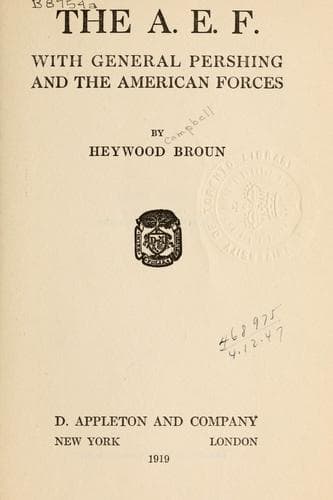
The A. E. F.: With General Pershing and the American ForcesBroun, Heywood
History
The A. E. F.: With General Pershing and the American Forces
Broun, Heywood
United States. Army. American Expeditionary Forces; World War, 1914-1918 -- Personal narratives
The windows of the cars were crowded with faces as the train came slowly
into the station. There was no shouting until the big man made his
speech. Some of the returned prisoners waved their hands, but most of
them greeted the soldiers and the crowds which waited for them with
formal salutes. A file of soldiers was drawn up along the platform and
outside the station was a squad of cavalry trying to stand just as
motionless as the infantry. There were horns and trumpets inside the
station and out and they blew a nipping, rollicking tune as the train
rolled in. The wounded men, all but a few on stretchers, descended from
the cars in military order. Lame men with canes hopped and skipped in
order to keep step with their more nimble comrades.
There was an old woman in black who darted out from the crowd and wanted
to throw her arms around the neck of a young soldier, but he waved to
her not to come. You see she still thought of him as a boy, but that had
been three years ago. He was a marching man now and it would never do to
break the formation. Group by group they came from the train with a new
blare of the trumpets for each unit. There were 416 French soldiers,
thirty-seven French officers and seventeen Belgians. They marched past
the receiving group of officers and saluted punctiliously, though it was
a little bit hard because their arms were full of flowers. When they had
all been gathered in the waiting room of the station the big colonel
made his speech. He did not speak very long because the returned
soldiers could see out of the corner of their eyes that just across the
room were big tables with scores of expectant and anticipatory bottles
of champagne. But there was fizz, too, to the talk of the big colonel. I
had the speech translated for me afterwards but I guessed that some of
it was about the Germans, for I caught the phrase "inhuman cruelty."
"You have a right to feel now that you are back on the soil of France
after all these years of inhuman cruelty that your work is done," said
the colonel, "but there is still something that you must do. There is
something that you ought to do. You will tell everybody of the wrongs
the Germans have inflicted upon you. You will tell exactly what they
have done and you will thus serve France by increasing the hatred
between our people and their people."
The soldiers and the crowd cheered then almost as loudly as they did
later in the great shout of "Vive la France." The gray men, the grim men
and the silent men were stirred by what the colonel said because they
did and will forever have a quarrel with the German people.
"We are doubly glad to welcome you back to France because our hearts
have been so cheered by the coming of America," continued the colonel.
"Victory seems nearer and nearer and vengeance for all the things you
have endured." It was then that he snatched the great shout of "Vive la
France" from the crowd.
Public-domain text, read in full here on John Shaqi.
Reviews
Reviews
No reviews yet
Be the first to share your thoughts on this work.
Elsewhere in the archive
Join the Discussion
Join the discussion
Sign in to leave a comment or review.
Sign InorCreate an account