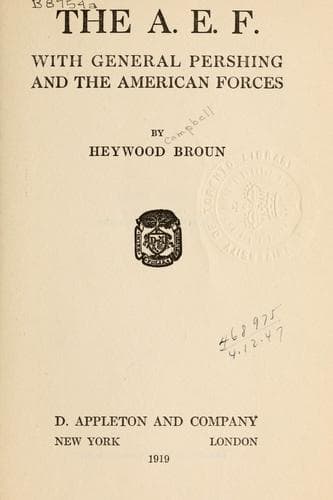
The A. E. F.: With General Pershing and the American ForcesBroun, Heywood
History
The A. E. F.: With General Pershing and the American Forces
Broun, Heywood
United States. Army. American Expeditionary Forces; World War, 1914-1918 -- Personal narratives
As the din died down the corks began to pop and men who a little time
before had not even been sure of a proper ration of water began to gulp
champagne out of tin cups. The sting of the wine, the excitement and the
din were too much for one returned prisoner. He had scarcely lifted his
glass to his lips than he fell over in a heap and there was one more
weary wanderer to make his return sickabed in a stretcher. But the rest
marched better as they came out of the station with band tunes blaring
in their ears and God knows what tunes singing in their hearts as they
clanked along the cobbles. For they had been dead men and they were back
in France and there was sun in the sky. When they crossed the bridge
they broke ranks. The old woman in black was there and for just a minute
the marching man became a boy again.
CHAPTER XVIII
FINISHING TOUCHES
The American army had begun to find itself when October came round.
Perhaps it had not yet gained a complete army consciousness, but there
could be no doubt about company spirit. Chaps who had been civilians
only a few months before now spoke of "my company" as if they had grown
up with the outfit. They were also ready to declare loudly and profanely
in public places that H or L or K or I, as the case might be, was the
best company in the army. Some were willing to let the remark stand for
the world.
Too much credit cannot be given to the captains of the first American
Expeditionary Force. A captain commands more men now than ever before in
the American army and he has more power. This was particularly true in
France where many companies had a little village to themselves. The
captain, therefore, was not only a military leader, a father confessor,
and a gents' furnisher, but also an ambassador to the people of a small
section of France. The colonels and majors and the rest are the fellows
who think up things to be done, but it is the captains who do them.
Of course that wasn't the way the junior officers looked at it. A man
who was a first lieutenant when the army came to France told us: "A
first lieutenant is supposed to know everything and do everything; a
captain is supposed to know everything and do nothing, and a major is
supposed to know nothing and do nothing."
We were delighted early this year when we heard that he had been made a
major, for we immediately sat down and telegraphed to him: "After what
you told us this summer, we are sure you will be an excellent major."
Public-domain text, read in full here on John Shaqi.
Reviews
Reviews
No reviews yet
Be the first to share your thoughts on this work.
Elsewhere in the archive
Join the Discussion
Join the discussion
Sign in to leave a comment or review.
Sign InorCreate an account