The Abenaki Indians: Their Treaties of 1713 & 1717, and a VocabularyKidder, Frederic
History
The Abenaki Indians: Their Treaties of 1713 & 1717, and a Vocabulary
Kidder, Frederic
Abenaki Indians; Abenaki Indians -- Treaties; Abenaki language
Produced by Jeannie Howse, Chuck Greif, Anne Storer and
the Online Distributed Proofreading Team at
http://www.pgdp.net (This file was produced from images
generously made available by the Canadian Institute for
Historical Microreproductions (www.canadiana.org))
Transcriber's Notes:
1) Some treaty signatures are unclear and have been marked and/or
best-guessed. Original signature images can be seen in the html
version.
2) The breve has been rendered as [)c] and the macron [o=]
3) Text following ^ is superscripted.
4) Unusual and inconsistent spelling of place/names have been left as
in the original.
* * * * *
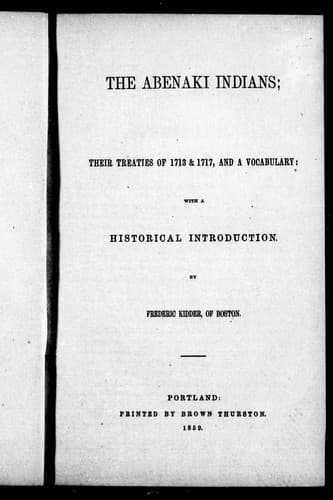
THE ABENAKI INDIANS;
THEIR TREATIES OF 1713 & 1717, AND A VOCABULARY:
WITH A
HISTORICAL INTRODUCTION.
BY
FREDERIC KIDDER, OF BOSTON.
PORTLAND:
PRINTED BY BROWN THURSTON.
1859.
THE ABENAKI INDIANS.
The present spirit of inquiry into the early history of New England is
bringing forth additional facts and evolving new light, by which we are
every day seeing more clearly the true motive and incentives for its
colonization. But whenever the student turns to investigate the history
of the aboriginal tribes, who once inhabited this part of the country,
he is struck, not so much with the paucity of materials, as with the
complication and difficulties which our earlier and later writers have
thrown around the subject, as well as the very different light with
which they have viewed it.
The first explorers of our coast, whose intercourse with the Indians was
limited to trading for furs and skins, seem to have had a much better
opinion of them than Mather, Hubbard, and some still later writers. It
is not to be supposed that while a large part of the population were
smarting from the distress of almost continued Indian wars, that even
the most candid could coolly investigate and impartially record the
history, character, and wants of such a people. But the time has
arrived, when, divesting ourselves of all prejudice, we can examine
carefully their true situation, and making allowance for their
condition, write their history with fairness and candor.
The present sketch is confined to a brief notice of the tribes who
inhabited the territory now constituting the States of Maine and New
Hampshire, all of which may be considered as embraced under the name of
Abenakis, or more properly Wanbanakkie. It has often been supposed that
this name was given them by the French, but it is undoubtedly their
original appellation, being derived from Wanbanban, which may be defined
the people of aurora borealis or northern light.
Public-domain text, read in full here on John Shaqi.
Reviews
Reviews
No reviews yet
Be the first to share your thoughts on this work.
Join the Discussion
Join the discussion
Sign in to leave a comment or review.
Sign InorCreate an account