The Abenaki Indians: Their Treaties of 1713 & 1717, and a Vocabulary — John Shaqi
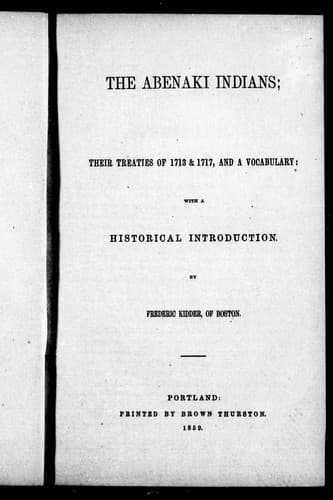
The Abenaki Indians: Their Treaties of 1713 & 1717, and a VocabularyKidder, Frederic
History
The Abenaki Indians: Their Treaties of 1713 & 1717, and a Vocabulary
Kidder, Frederic
Abenaki Indians; Abenaki Indians -- Treaties; Abenaki language
It is only now intended to sketch their earlier history, and to trace
the various emigrations to the present residence of the Abenakis proper,
in Canada; and viewing this tribe as the living representative of our
extinct ones, to consider its interesting history, so clearly connected
with New England frontier life, although most of that history is but a
record of war and wretchedness.
The celebrated discoverer, Capt. John Smith, in his general history,
furnishes the earliest and most reliable description of the Indians on
the coast of Maine, as they were in 1614; other writers give accounts of
tribes there, some of which it is difficult to distinguish or locate;
but it may be best to consider all that were residing in the two States
above-mentioned as embraced in about eight distinct tribes, namely:
Penobscots or Tarrentines, Passamaquodies or Sybayks, Wawenocks,
Norridgewoks or Canibas, Assagunticooks, Sokokis or Pequakets,
Pennacooks, Malacites or St. Johns.
The Penobscots[1] were probably the most numerous and influential tribe.
Their chief or bashaba was said to have been acknowledged as a superior
as far as Massachusetts Bay. They occupied the country on both sides of
the Penobscot Bay and River; their summer resort being near the sea, but
during the winter and spring they inhabited lands near the falls, where
they still reside. It is somewhat strange to find a tribe numbering
about five hundred still remaining in their ancient abode, and, though
surrounded by whites, retaining their language, religion, and many of
the habits and customs of centuries past, with a probability of
perpetuating them for ages to come. Their name is from _penobsq_, rock,
and _utoret_, a place, literally, rocky-place,--which no doubt refers to
the rocky falls in the river near their residence. It is not supposed
that many of this tribe emigrated to Canada, although they had constant
intercourse with that country.
[1] For a pleasant and very well-written account of this tribe, by Hon.
Lorenzo Sabine, see the Christian Examiner for 1857.
The Passamaquodies were found occupying the northeastern corner of
Maine, if, as it is generally supposed, they are the descendants of
those seen and described by De Monts, who spent the winter of 1604 near
their present head-quarters. Their subsequent history for more than a
century was but a blank, as in all that time they are not mentioned by
any writer, or named in any of the treaties, till after the conquest of
Canada. This omission is certainly strange, as in the ones of 1713 and
1717 now published in this volume, mere fragments of tribes are named
and represented.
Public-domain text, read in full here on John Shaqi.
Reviews
Reviews
No reviews yet
Be the first to share your thoughts on this work.
Join the Discussion
Join the discussion
Sign in to leave a comment or review.
Sign InorCreate an account