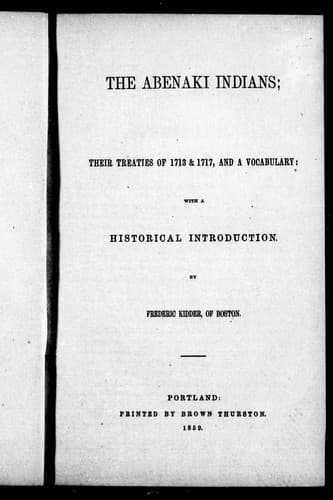
The Abenaki Indians: Their Treaties of 1713 & 1717, and a VocabularyKidder, Frederic
History
The Abenaki Indians: Their Treaties of 1713 & 1717, and a Vocabulary
Kidder, Frederic
Abenaki Indians; Abenaki Indians -- Treaties; Abenaki language
Still, if any reliance can be placed on their own traditions, they had
resided for generations previous to the Revolution around the lower
Schoodic Lake, where the recent discovery of stone hatchets and other
implements of an ancient make would seem to verify their assertions.
They also point out the place of a fight with the Mohawks, who two
centuries ago carried terror into all the Indian villages from Carolina
to the Bay of Fundy. It is probable that from their distant inland and
secluded position, as well as their limited numbers, they were in no way
connected with the various wars which the other tribes waged against the
colonists, and so were unnoticed. As their residence on the lake was
nearer Machias than any other available point on the sea coast, it may
be that to trade with this people the trading house was established
there by the Plymouth Colony, in 1630, and they were often called the
Machias Indians. Although their intercourse has long continued with
Canada, up to this time they have sent no emigrants there. They number
at present between four and five hundred souls, and still adhere to the
religious forms taught them by the Jesuits. This tribe designate
themselves by the name of Sybayk.[2]
[2] Mr. Sabine has given their history in a truthful and friendly
communication to the Christian Examiner for 1852.
The Wawenocks were located on the sea-coast, and inhabited the country
from the Sheepscot to the St. George; they are quite fully described by
Capt. John Smith, who had much intercourse with them. From their
situation on the rivers and harbors, they were much sooner disturbed by
the settlements than any other of the tribes in Maine. In 1747 there
were but a few families remaining. At the treaty at Falmouth, in 1749,
they were associated with the Assagunticooks, among whom they were then
settled, and with whom they soon after removed to Canada. The Canibas or
Norridgewoks occupied the valley of the Kennebec, from the tide water to
its sources; their principal residence was at Norridgewock. Here the
Jesuit missionaries, at an early period, taught them their religious
faith, and by sharing with them their privations and hardships, obtained
a controlling influence over them.
Public-domain text, read in full here on John Shaqi.
Reviews
Reviews
No reviews yet
Be the first to share your thoughts on this work.
Join the Discussion
Join the discussion
Sign in to leave a comment or review.
Sign InorCreate an account