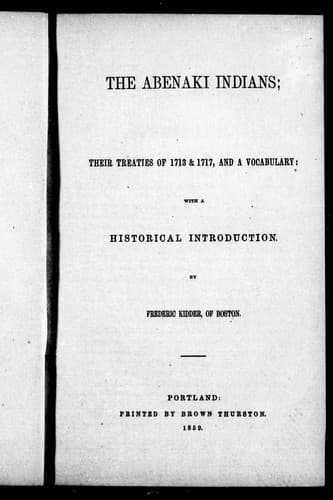
The Abenaki Indians: Their Treaties of 1713 & 1717, and a Vocabulary — John Shaqi
The Abenaki Indians: Their Treaties of 1713 & 1717, and a VocabularyKidder, Frederic
History
The Abenaki Indians: Their Treaties of 1713 & 1717, and a Vocabulary
Kidder, Frederic
Abenaki Indians; Abenaki Indians -- Treaties; Abenaki language
In November, 1724, Vaudreuil, Governor General of Canada, addressed an
urgent letter to the Minister of War in France, giving an account of the
attack on Norridgewock, and the death of Father Rasle, with a full
account of the losses and sufferings of that tribe, and asking for a
grant of ammunition, guns, and blankets to supply their losses, and
enable them to make war on the English settlements. He also gives a
particular account of the condition of the Abenakis, and says, "of all
the Indians in New France, they are in a position to render the most
service; this nation consists of five villages, which number,
altogether, about five hundred warriors. Two of these villages are
situated on the St. Lawrence, near Three Rivers--one below that town
called Beçancour, the other ten leagues above, called St. Francis, the
three others are in the direction of Acadie, called Narantsouak, on the
River Kanibekky, Panagamsdé, on the Pentagouet (Penobscot), and
Medocteck, on the River St. John. These three villages have different
routes, each by its own river, whereby they can reach Quebeck in a few
days."[3]
[3] See N. Y. Colonial Documents, edited by E. B. O'Calligan, LL. D.
In April, 1725, a delegation of three gentlemen visited Montreal with a
letter from the Governor of Massachusetts, in reply to one addressed to
him some months previously by M. Vaudreuil, relative to the attack at
Norridgewock, and the death of Father Rasle. They demanded that the
prisoners held by the Abenakis should be given up, and a perpetual peace
established.
The Indians, who were entirely under the influence of the French, were
extremely haughty in their language and deportment; they demanded that
the English should restore their lands, rebuild their church, which they
had destroyed at Norridgewock, and when asked what land they referred
to, said "that their land commenced at the River Gounitogon, otherwise
called the long river,[4] which lies to the west beyond Boston, that
this river was formerly the boundary which separated the lands of the
Iroquois from those of the Abenakis, that according to this boundary,
Boston and the greater part of the English settlements east of it are in
Abenakis' lands; that they would be justified in telling them to quit
there, but that they had considered that their settlements were
established and that they were still inclined to tolerate them; but they
demanded as an express condition of peace that the English should
abandon the country from one league beyond Saco River to Port Royal,
which was the line separating the lands of the Abenakis from those of
the Micmaks."[5]
[4] Undoubtedly the Connecticut.
[5] N. Y. Colonial Documents, vol. ix.
Public-domain text, read in full here on John Shaqi.
Reviews
Reviews
No reviews yet
Be the first to share your thoughts on this work.
Join the Discussion
Join the discussion
Sign in to leave a comment or review.
Sign InorCreate an account