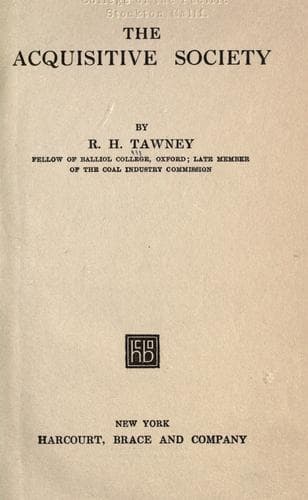
The Acquisitive SocietyTawney, R. H. (Richard Henry)
Philosophy
The Acquisitive Society
Tawney, R. H. (Richard Henry)
Economics; Industries; Social problems
Two causes appear to have hampered the committees which were
established in connection with coal mines during the war to increase
the output of coal. One was the reluctance of some of them to
discharge the invidious task of imposing penalties for absenteeism on
their fellow-workmen. The other was the exclusion of faults of
management from the control of many committees. In some cases all went
well till they demanded that, if the miners were penalized for
absenteeism which was due to them, the management should be penalized
similarly when men who desired to work were sent home because, as a
result of defective organization, there was no work for them to do.
Their demand was resisted as "interference with the management," and
the attempt to enforce regularity of attendance broke down. Nor, to
take another example from the same industry, is it to be expected that
the weight of the miners' organization will be thrown on to the side of
greater production, if it has no power to insist on the removal of the
defects of equipment and organization, the shortage of trams, rails,
tubs and timber, the "creaming" of the pits by the working of easily
got coal to their future detriment, their wasteful layout caused by the
vagaries of separate ownership, by which at present the output is
reduced.
The public cannot have it both ways. If it allows workmen to be
treated as "hands" it cannot claim the service of their wills and their
brains. If it desires them to show the zeal of skilled professionals,
it must secure that they have sufficient power to allow of their
discharging professional responsibilities. In order that workmen may
abolish any restrictions on output which {153} may be imposed by them,
they must be able to insist on the abolition of the restrictions, more
mischievous because more effective, which, as the Committee on Trusts
has recently told us, are imposed by organizations of employers. In
order that the miners' leaders, instead of merely bargaining as to
wages, hours and working conditions, may be able to appeal to their
members to increase the supply of coal, they must be in a position to
secure the removal of the causes of low output which are due to the
deficiencies of the management, and which are to-day a far more serious
obstacle than any reluctance on the part of the miner. If the workmen
in the building trade are to take combined action to accelerate
production, they must as a body be consulted as to the purpose to which
their energy is to be applied, and must not be expected to build
fashionable houses, when what are required are six-roomed cottages to
house families which are at present living with three persons to a room.
Public-domain text, read in full here on John Shaqi.
Reviews
Reviews
No reviews yet
Be the first to share your thoughts on this work.
Elsewhere in the archive
Join the Discussion
Join the discussion
Sign in to leave a comment or review.
Sign InorCreate an account