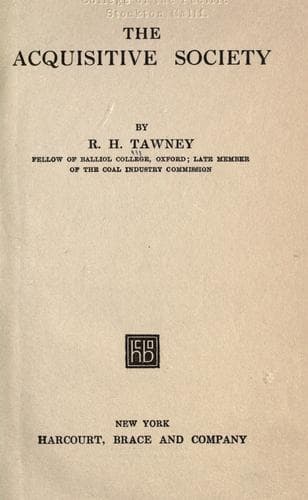
The Acquisitive SocietyTawney, R. H. (Richard Henry)
Philosophy
The Acquisitive Society
Tawney, R. H. (Richard Henry)
Economics; Industries; Social problems
It is deplorable, indeed, that any human beings should consent to
degrade themselves by producing the articles which a considerable
number of workmen turn out to-day, boots which are partly brown paper,
and furniture which is not fit to use. The revenge of outraged
humanity is certain, though it is not always obvious; and the penalty
paid by the consumer for tolerating an organization of industry which,
in the name of efficiency, destroyed the responsibility of the workman,
is that the service with which he is provided is not even efficient.
He has always paid it, though he has not seen it, in quality. To-day
he is beginning to {154} realize that he is likely to pay it in
quantity as well. If the public is to get efficient service, it can
get it only from human beings, with the initiative and caprices of
human beings. It will get it, in short, in so far as it treats
industry as a responsible profession.
The collective responsibility of the workers for the maintenance of the
standards of their profession is, then, the alternative to the
discipline which Capitalism exercised in the past, and which is now
breaking down. It involves a fundamental change in the position both
of employers and of trade unions. As long as the direction of industry
is in the hands of property-owners or their agents, who are concerned
to extract from it the maximum profit for themselves, a trade union is
necessarily a defensive organization. Absorbed, on the one hand, in
the struggle to resist the downward thrust of Capitalism upon the
workers' standard of life, and denounced, on the other, if it presumes,
to "interfere with management," even when management is most obviously
inefficient, it is an opposition which never becomes a government and
which has neither the will nor the power to assume responsibility for
the quality of the service offered to the consumer. If the abolition
of functionless property transferred the control of production to
bodies representing those who perform constructive work and those who
consume the goods produced, the relation of the worker to the public
would no longer be indirect but immediate, and associations which are
now purely defensive would be in a position not merely to criticize and
oppose but to advise, to initiate and to enforce upon their own members
the obligations of the craft.
{155}
Public-domain text, read in full here on John Shaqi.
Reviews
Reviews
No reviews yet
Be the first to share your thoughts on this work.
Elsewhere in the archive
Join the Discussion
Join the discussion
Sign in to leave a comment or review.
Sign InorCreate an account