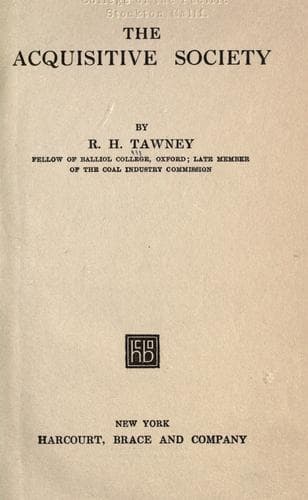
The Acquisitive SocietyTawney, R. H. (Richard Henry)
Philosophy
The Acquisitive Society
Tawney, R. H. (Richard Henry)
Economics; Industries; Social problems
It is obvious that in such circumstances the service offered the
consumer, however carefully safeguarded by his representation on the
authorities controlling each industry, would depend primarily upon the
success of professional organizations in finding a substitute for the
discipline exercised to-day by the agents of property-owners. It would
be necessary for them to maintain by their own action the zeal,
efficiency and professional pride which, when the barbarous weapons of
the nineteenth century have been discarded, would be the only guarantee
of a high level of production. Nor, once this new function has been
made possible for professional organizations, is there any extravagance
in expecting them to perform it with reasonable competence. How far
economic motives are balked to-day and could be strengthened by a
different type of industrial organization, to what extent, and under
what conditions, it is possible to enlist in the services of industry
motives which are not purely economic, can be ascertained only after a
study of the psychology of work which has not yet been made. Such a
study, to be of value, must start by abandoning the conventional
assumptions, popularized by economic textbooks and accepted as
self-evident by practical men, that the motives to effort are simple
and constant in character, like the pressure of steam in a boiler, that
they are identical throughout all ranges of economic activity, from the
stock exchange to the shunting of wagons or laying of bricks, and that
they can be elicited and strengthened only by directly economic
incentives. In so far as motives in industry have been considered
hitherto, it has usually been done {156} by writers who, like most
exponents of scientific management, have started by assuming that the
categories of business psychology could be offered with equal success
to all classes of workers and to all types of productive work. Those
categories appear to be derived from a simplified analysis of the
mental processes of the company promoter, financier or investor, and
their validity as an interpretation of the motives and habits which
determine the attitude to his work of the bricklayer, the miner, the
dock laborer or the engineer, is precisely the point in question.
Public-domain text, read in full here on John Shaqi.
Reviews
Reviews
No reviews yet
Be the first to share your thoughts on this work.
Elsewhere in the archive
Join the Discussion
Join the discussion
Sign in to leave a comment or review.
Sign InorCreate an account