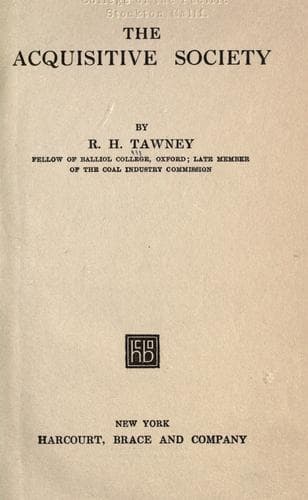
The Acquisitive SocietyTawney, R. H. (Richard Henry)
Philosophy
The Acquisitive Society
Tawney, R. H. (Richard Henry)
Economics; Industries; Social problems
Clearly there are certain types of industry to which they are only
partially relevant. It can hardly be assumed, for example, that the
degree of skill and energy brought to his work by a surgeon, a
scientific investigator, a teacher, a medical officer of health, an
Indian civil servant and a peasant proprietor are capable of being
expressed precisely and to the same degree in terms of the economic
advantage which those different occupations offer. Obviously those who
pursue them are influenced to some considerable, though uncertain,
extent by economic incentives. Obviously, again, the precise character
of each process or step in the exercise of their respective avocations,
the performance of an operation, the carrying out of a piece of
investigation, the selection of a particular type of educational
method, the preparation of a report, the decision of a case or the care
of live stock, is not immediately dependent upon an exact calculation
of pecuniary gain or loss. What appears to be the case is that in
certain walks of life, while the occupation is chosen after a
consideration of {157} its economic advantages, and while economic
reasons exact the minimum degree of activity needed to avert dismissal
from it or "failure," the actual level of energy or proficiency
displayed depend largely upon conditions of a different order. Among
them are the character of the training received before and after
entering the occupation, the customary standard of effort demanded by
the public opinion of one's fellows, the desire for the esteem of the
small circle in which the individual moves and to be recognized as
having "made good" and not to have "failed," interest in one's work,
ranging from devotion to a determination to "do justice" to it, the
pride of the craftsman, the "tradition of the service."
Public-domain text, read in full here on John Shaqi.
Reviews
Reviews
No reviews yet
Be the first to share your thoughts on this work.
Elsewhere in the archive
Join the Discussion
Join the discussion
Sign in to leave a comment or review.
Sign InorCreate an account