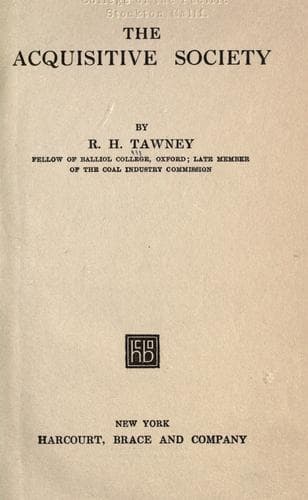
The Acquisitive SocietyTawney, R. H. (Richard Henry)
Philosophy
The Acquisitive Society
Tawney, R. H. (Richard Henry)
Economics; Industries; Social problems
During the greater part of the nineteenth century the significance of
the opposition between the two principles of individual rights and
social functions was masked by the doctrine of the inevitable harmony
between private interests and public good. Competition, it was argued,
was an effective substitute for honesty. To-day that subsidiary
doctrine has fallen to pieces under criticism; few now would profess
adherence to the compound of economic optimism and moral bankruptcy
which led a nineteenth century economist to say: "Greed is held in
check by greed, and the desire for gain sets limits to itself." The
disposition to regard individual rights as the center and pivot of
society is still, however, the most powerful element in political
thought and the practical foundation of industrial organization. The
laborious refutation of the doctrine that private and public interests
are co-incident, and that man's self-love is God's Providence, which
was the excuse of the last century for its worship of economic egotism,
has achieved, in fact, surprisingly small results. Economic egotism is
still worshiped; and it is worshiped because that doctrine was not
really the center of the position. It was an outwork, not the citadel,
and now that the outwork has been captured, the citadel is still to win.
What gives its special quality and character, its toughness and
cohesion, to the industrial system built up in the last century and a
half, is not its exploded theory of economic harmonies. It is the
doctrine that {28} economic rights are anterior to, and independent of
economic functions, that they stand by their own virtue, and need
adduce no higher credentials. The practical result of it is that
economic rights remain, whether economic functions are performed or
not. They remain to-day in a more menacing form than in the age of
early industrialism. For those who control industry no longer compete
but combine, and the rivalry between property in capital and property
in land has long since ended. The basis of the New Conservatism
appears to be a determination so to organize society, both by political
and economic action, as to make it secure against every attempt to
extinguish payments which are made, not for service, but because the
owners possess a right to extract income without it. Hence the fusion
of the two traditional parties, the proposed "strengthening" of the
second chamber, the return to protection, the swift conversion of rival
industrialists to the advantages of monopoly, and the attempts to buy
off with concessions the more influential section of the working
classes. Revolutions, as a long and bitter experience reveals, are apt
to take their color from the regime which they overthrow. Is it any
wonder that the creed which affirms the absolute rights of property
should sometimes be met with a counter-affirmation of the absolute
rights of labor, less anti-social, indeed, and inhuman, but almost as
Public-domain text, read in full here on John Shaqi.
Reviews
Reviews
No reviews yet
Be the first to share your thoughts on this work.
Join the Discussion
Join the discussion
Sign in to leave a comment or review.
Sign InorCreate an account