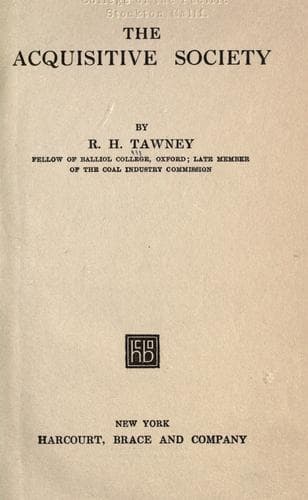
The Acquisitive SocietyTawney, R. H. (Richard Henry)
Philosophy
The Acquisitive Society
Tawney, R. H. (Richard Henry)
Economics; Industries; Social problems
dogmatic, almost as intolerant and thoughtless as itself?
A society which aimed at making the acquisition of wealth contingent
upon the discharge of social {29} obligations, which sought to
proportion remuneration to service and denied it to those by whom no
service was performed, which inquired first not what men possess but
what they can make or create or achieve, might be called a Functional
Society, because in such a society the main subject of social emphasis
would be the performance of functions. But such a society does not
exist, even as a remote ideal, in the modern world, though something
like it has hung, an unrealized theory, before men's minds in the past.
Modern societies aim at protecting economic rights, while leaving
economic functions, except in moments of abnormal emergency, to fulfil
themselves. The motive which gives color and quality to their public
institutions, to their policy and political thought, is not the attempt
to secure the fulfilment of tasks undertaken for the public service,
but to increase the opportunities open to individuals of attaining the
objects which they conceive to be advantageous to themselves. If asked
the end or criterion of social organization, they would give an answer
reminiscent of the formula the greatest happiness of the greatest
number. But to say that the end of social institutions is happiness,
is to say that they have no common end at all. For happiness is
individual, and to make happiness the object of society is to resolve
society itself into the ambitions of numberless individuals, each
directed towards the attainment of some personal purpose.
Public-domain text, read in full here on John Shaqi.
Reviews
Reviews
No reviews yet
Be the first to share your thoughts on this work.
Join the Discussion
Join the discussion
Sign in to leave a comment or review.
Sign InorCreate an account