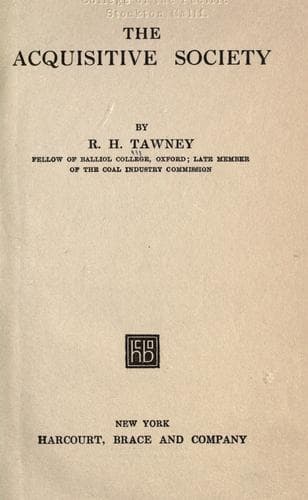
The Acquisitive SocietyTawney, R. H. (Richard Henry)
Philosophy
The Acquisitive Society
Tawney, R. H. (Richard Henry)
Economics; Industries; Social problems
Thus part of the goods which are annually produced, and which are
called wealth, is, strictly speaking, waste, because it consists of
articles which, though reckoned as part of the income of the nation,
either should not have been produced until other articles had already
{38} been produced in sufficient abundance, or should not have been
produced at all. And some part of the population is employed in making
goods which no man can make with happiness, or indeed without loss of
self-respect, because he knows that they had much better not be made;
and that his life is wasted in making them. Everybody recognizes that
the army contractor who, in time of war, set several hundred navvies to
dig an artificial lake in his grounds, was not adding to, but
subtracting from, the wealth of the nation. But in time of peace many
hundred thousand workmen, if they are not digging ponds, are doing work
which is equally foolish and wasteful; though, in peace, as in war,
there is important work, which is waiting to be done, and which is
neglected. It is neglected because, while the effective demand of the
mass of men is only too small, there is a small class which wears
several men's clothes, eats several men's dinners, occupies several
families' houses, and lives several men's lives. As long as a minority
has so large an income that part of it, if spent at all, must be spent
on trivialities, so long will part of the human energy and mechanical
equipment of the nation be diverted from serious work, which enriches
it, to making trivialities, which impoverishes it, since they can only
be made at the cost of not making other things. And if the peers and
millionaires who are now preaching the duty of production to miners and
dock laborers desire that more wealth, not more waste, should be
produced, the simplest way in which they can achieve their aim is to
transfer to the public their whole incomes over (say) $5,000 a year, in
order that it may {39} be spent in setting to work, not gardeners,
chauffeurs, domestic servants and shopkeepers in the West End of
London, but builders, mechanics and teachers.
Public-domain text, read in full here on John Shaqi.
Reviews
Reviews
No reviews yet
Be the first to share your thoughts on this work.
Join the Discussion
Join the discussion
Sign in to leave a comment or review.
Sign InorCreate an account