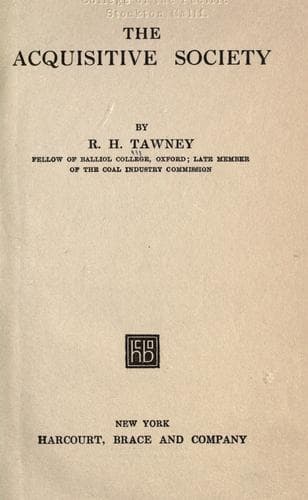
The Acquisitive SocietyTawney, R. H. (Richard Henry)
Philosophy
The Acquisitive Society
Tawney, R. H. (Richard Henry)
Economics; Industries; Social problems
A society ruled by these notions is necessarily the victim of an
irrational inequality. To escape such inequality it is necessary to
recognize that there is some principle which ought to limit the gains
of particular classes and particular individuals, because gains drawn
from certain sources or exceeding certain amounts are illegitimate.
But such a limitation implies a {37} standard of discrimination, which
is inconsistent with the assumption that each man has a right to what
he can get, irrespective of any service rendered for it. Thus
privilege, which was to have been exorcised by the gospel of 1789,
returns in a new guise, the creature no longer of unequal legal rights
thwarting the natural exercise of equal powers of hand and brain, but
of unequal powers springing from the exercise of equal rights in a
world where property and inherited wealth and the apparatus of class
institutions have made opportunities unequal. Inequality, again, leads
to the mis-direction of production. For, since the demand of one
income of L50,000 is as powerful a magnet as the demand of 500 incomes
of L100, it diverts energy from the creation of wealth to the
multiplication of luxuries, so that, for example, while one-tenth of
the people of England are overcrowded, a considerable part of them are
engaged, not in supplying that deficiency, but in making rich men's
hotels, luxurious yachts, and motorcars like that used by the Secretary
of State for War, "with an interior inlaid with silver in quartered
mahogany, and upholstered in fawn suede and morocco," which was
recently bought by a suburban capitalist, by way of encouraging useful
industries and rebuking public extravagance with an example of private
economy, for the trifling sum of $14,000.
Public-domain text, read in full here on John Shaqi.
Reviews
Reviews
No reviews yet
Be the first to share your thoughts on this work.
Join the Discussion
Join the discussion
Sign in to leave a comment or review.
Sign InorCreate an account