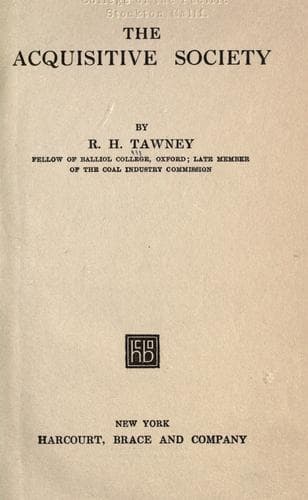
The Acquisitive SocietyTawney, R. H. (Richard Henry)
Philosophy
The Acquisitive Society
Tawney, R. H. (Richard Henry)
Economics; Industries; Social problems
Thus, as long as men move on this plane, there is no solution. They
can obtain peace only by surrendering the claim to the unfettered
exercise of their rights, which is the cause of war. What we have been
witnessing, in short, during the past five years, both in international
affairs and in industry, is the breakdown of the organization of
society on the basis of rights divorced from obligations. Sooner or
later the collapse was inevitable, because the basis was too narrow.
For a right is simply a power which is secured by legal sanctions, "a
capacity," as the lawyers define it, "residing in one man, of
controlling, with the assistance of the State, the action of others,"
and a right should not be absolute for the same reason that a power
should not be absolute. No doubt it is better that individuals should
have absolute rights than that the State or the Government should have
them; and it was the reaction against the abuses of absolute power by
the State which led in the eighteenth century to the declaration of the
absolute rights of individuals. {51} The most obvious defense against
the assertion of one extreme was the assertion of the other. Because
Governments and the relics of feudalism had encroached upon the
property of individuals it was affirmed that the right of property was
absolute; because they had strangled enterprise, it was affirmed that
every man had a natural right to conduct his business as he pleased.
But, in reality, both the one assertion and the other are false, and,
if applied to practice, must lead to disaster. The State has no
absolute rights; they are limited by its commission. The individual
has no absolute rights; they are relative to the function which he
performs in the community of which he is a member, because, unless they
are so limited, the consequences must be something in the nature of
private war. All rights, in short, are conditional and derivative,
because all power should be conditional and derivative. They are
derived from the end or purpose of the society in which they exist.
They are conditional on being used to contribute to the attainment of
that end, not to thwart it. And this means in practice that, if
society is to be healthy, men must regard themselves not as the owners
of rights, but as trustees for the discharge of functions and the
instruments of a social purpose.
{52}
V
PROPERTY AND CREATIVE WORK
Public-domain text, read in full here on John Shaqi.
Reviews
Reviews
No reviews yet
Be the first to share your thoughts on this work.
Join the Discussion
Join the discussion
Sign in to leave a comment or review.
Sign InorCreate an account