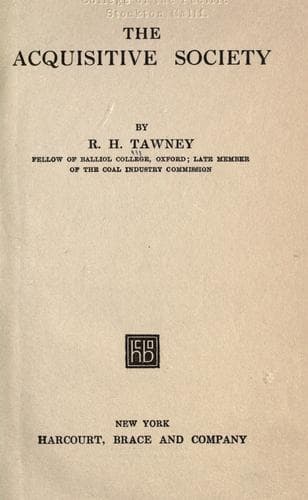
The Acquisitive SocietyTawney, R. H. (Richard Henry)
Philosophy
The Acquisitive Society
Tawney, R. H. (Richard Henry)
Economics; Industries; Social problems
The application of the principle that society should be organized upon
the basis of functions, is not recondite, but simple and direct. It
offers in the first place, a standard for discriminating between those
types of private property which are legitimate and those which are not.
During the last century and a half, political thought has oscillated
between two conceptions of property, both of which, in their different
ways, are extravagant. On the one hand, the practical foundation of
social organization has been the doctrine that the particular forms of
private property which exist at any moment are a thing sacred and
inviolable, that anything may properly become the object of property
rights, and that, when it does, the title to it is absolute and
unconditioned. The modern industrial system took shape in an age when
this theory of property was triumphant. The American Constitution and
the French Declaration of the Rights of Man both treated property as
one of the fundamental rights which Governments exist to protect. The
English Revolution of 1688, undogmatic and reticent though it was, had
in effect done the same. The great individualists from Locke to
Turgot, Adam Smith and Bentham all repeated, in different language, a
similar conception. Though what gave the Revolution its {53}
diabolical character in the eyes of the English upper classes was its
treatment of property, the dogma of the sanctity of private property
was maintained as tenaciously by French Jacobins as by English Tories;
and the theory that property is an absolute, which is held by many
modern Conservatives, is identical, if only they knew it, with that not
only of the men of 1789, but of the Convention itself.
On the other hand, the attack has been almost as undiscriminating as
the defense. "Private property" has been the central position against
which the social movement of the last hundred years has directed its
forces. The criticism of it has ranged from an imaginative communism
in the most elementary and personal of necessaries, to prosaic and
partially realized proposals to transfer certain kinds of property from
private to public ownership, or to limit their exploitation by
restrictions imposed by the State. But, however varying in emphasis
and in method, the general note of what may conveniently be called the
Socialist criticism of property is what the word Socialism itself
implies. Its essence is the statement that the economic evils of
society are primarily due to the unregulated operation, under modern
conditions of industrial organization, of the institution of private
property.
Public-domain text, read in full here on John Shaqi.
Reviews
Reviews
No reviews yet
Be the first to share your thoughts on this work.
Join the Discussion
Join the discussion
Sign in to leave a comment or review.
Sign InorCreate an account