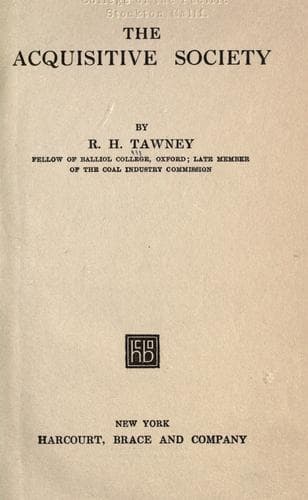
The Acquisitive SocietyTawney, R. H. (Richard Henry)
Philosophy
The Acquisitive Society
Tawney, R. H. (Richard Henry)
Economics; Industries; Social problems
The picture is plausible, but it is fallacious. It is fallacious not
merely in its crude assumption that a rise in wages necessarily
involves an increase in costs, but for another and more fundamental
reason. In reality the cause of economic confusion is not that the
demands of producer and consumer meet in blunt opposition; for, if they
did, their incompatibility, when they were incompatible, would be
obvious, and neither could deny his responsibility to the other,
however much he might seek to evade it. It is that they do not, but
that, as industry is organized to-day, what the worker foregoes the
general body of consumers does not necessarily gain, and what the
consumer pays the general body of workers does not necessarily receive.
If the circle is vicious, its vice is not that it is closed, but that
it is always half open, so that part of production leaks away in
consumption which adds nothing to productive energies, and that the
producer, because he knows this, does not fully use even the productive
energy which he commands.
It is the consciousness of this leak which sets every one at cross
purposes. No conceivable system of industrial organization can secure
industrial peace, if by "peace" is meant a complete absence of
disagreement. What could be secured would be that disagreements should
not flare up into a beacon of class warfare. If every member of a
group puts something into a common pool on condition of taking
something out, they may still quarrel about the size of the shares, as
children quarrel {132} over cake; but if the total is known and the
claims admitted, that is all they can quarrel about, and, since they
all stand on the same footing, any one who holds out for more than his
fellows must show some good reason why he should get it. But in
industry the claims are not all admitted, for those who put nothing in
demand to take something out; both the total to be divided and the
proportion in which the division takes place are sedulously concealed;
and those who preside over the distribution of the pool and control
what is paid out of it have a direct interest in securing as large a
share as possible for themselves and in allotting as small a share as
possible to others. If one contributor takes less, so far from it
being evident that the gain will go to some one who has put something
in and has as good a right as himself, it may go to some one who has
put in nothing and has no right at all. If another claims more, he may
secure it, without plundering a fellow-worker, at the expense of a
sleeping partner who is believed to plunder both. In practice, since
there is no clear principle determining what they ought to take, both
take all that they can get.
Public-domain text, read in full here on John Shaqi.
Reviews
Reviews
No reviews yet
Be the first to share your thoughts on this work.
Elsewhere in the archive
Join the Discussion
Join the discussion
Sign in to leave a comment or review.
Sign InorCreate an account