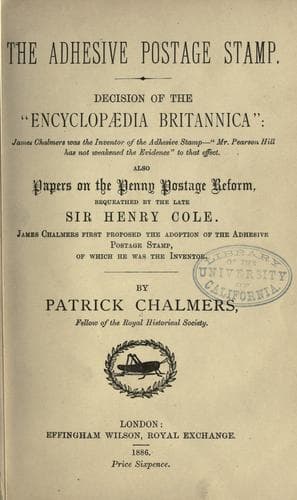
Chalmers, James, 1782-1853; Hill, Rowland, Sir, 1795-1879; Postage stamps
The nineteenth volume of the above-named standard work, lately
published, contains an article headed "Postage Stamps," in which my late
father is fully recognised as having been the inventor of the adhesive
postage stamp. It is well known that the articles in this work are drawn
up by learned experts upon the respective subjects dealt with, having
access to and being in the habit of consulting official and historical
documents, and edited under a strong sense of responsibility to the high
standing of the work itself and to history; so that it is with
unspeakable satisfaction that I now find myself enabled to produce from
such a quarter an emphatic recognition of my father's services in
connection with the great boon of Penny Postage reform.
This article, so far as it deals with the origin of the adhesive stamp,
is as follows; but in considering same it should be borne in mind that
the article was drawn up _before_ the discovery of Mr. Chalmers' plan
amongst the papers of the late Sir Henry Cole, with the consequent
proofs given in the last chapter as to Mr. Chalmers having taken the
initiative in urging the adoption of this stamp, not only to Members of
the Select Committee of the House of Commons of 1837-38, but to Mr.
Rowland Hill himself, long before Mr. Hill, in his paper of 1839 (see
_ante_, page 21), gave in his adhesion to that plan in conjunction with
his own:--
"POSTAGE STAMPS.--For all practical purposes the history of postage
stamps begins in the United Kingdom, and with the great reform of its
postal system in 1839-40." After giving instances in which the
_impressed_ stamp had been in use, or had been suggested for postal
purposes in this country and elsewhere, the article proceeds:--"Finally,
and in its results most important of all, the 'adhesive stamp' was made,
experimentally, in his printing-office at Dundee, by Mr. James Chalmers,
in August, 1834.[11] These experimental stamps were printed from
ordinary type, and were made adhesive by a wash of gum. Their inventor
had already won local distinction in matters of postal reform by his
strenuous and successful efforts, made as early as in the year 1822, for
the acceleration of the Scottish mails from London. Those efforts
resulted in a saving of forty-eight hours on the double journey, and
were highly appreciated in Scotland. There is evidence that from 1822
onwards his attention was much directed towards postal questions, and
that he held correspondence with the postal reformers of his day both in
and out of Parliament. It is also plain that he was more intent upon
aiding public improvements than upon winning credit for them. He made
adhesive stamps in 1834, and showed them to his neighbours, but took no
step for publicly recommending their adoption by the Post Office until
long after such a recommendation had been published--although very
hesitatingly--by the author of the now famous pamphlet entitled 'Post
Office Reform.'[12] Mr.
Public-domain text, read in full here on John Shaqi.
Reviews
Reviews
No reviews yet
Be the first to share your thoughts on this work.
Join the Discussion
Join the discussion
Sign in to leave a comment or review.
Sign InorCreate an account